Pronated, supinated, neutral stride: these terms appear in all running shoe guides. But what really underpins the choice of a pair suited to one’s biomechanics? Recent summaries in biomechanics challenge established beliefs: there is no solid evidence that anti-pronation shoes reduce injuries compared to neutral models chosen based on comfort. This finding changes the usual perspective.
Pronation, supination, and neutral stride: what a biomechanical test really measures
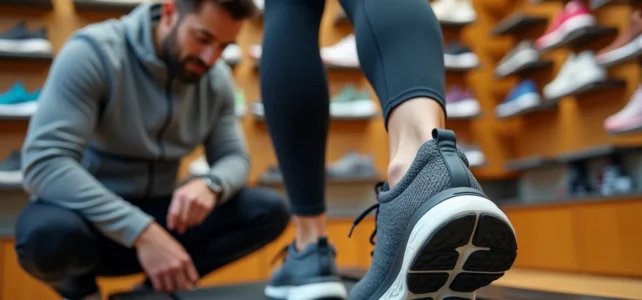
A gait test, conducted by a podiatrist or in a specialized store, films the foot’s movement in slow motion while running. The goal is to measure the internal (pronation) or external (supination) rotation amplitude of the ankle and rear foot at the moment of impact.
Pronation refers to the inward collapse of the foot. Supination corresponds to the opposite movement, outward. A so-called neutral or universal stride features an aligned roll-out, without marked tilting.
The wear on the soles of your everyday shoes provides an initial clue. As detailed in the article on Esprit Sport, wear concentrated on the inner edge indicates pronation, on the outer edge indicates supination, and central wear indicates a neutral stride.
| Type of stride | Foot movement | Sole wear area | Estimated percentage of runners |
|---|---|---|---|
| Pronation | Internal rotation | Inner edge | About 45% |
| Supination | External rotation | Outer edge | About 10% |
| Neutral / universal | Alignment | Center of the sole | About 45% |

Running shoes and stride correction: data challenges the classic reflex
The traditional model associates each type of stride with a category of shoe: stabilizing model for the pronator, cushioned and flexible model for the supinator, neutral model for others. This model remains omnipresent in the men’s and women’s sections of running stores.
Since the early 2020s, several literature reviews in biomechanics have shown that no robust study proves that a pronation control shoe protects better against injuries than a neutral model selected for comfort. The educational guide from Sportsland, which relies on these reviews, explicitly reminds us of this lack of evidence.
The practical consequence is direct. Choosing a pair solely because a test has identified overpronation guarantees nothing if the foot does not feel stable and comfortable in it. The comfort felt during fitting is more predictive than the pronator or supinator label stuck on the box.
Felt comfort versus stride category: the game-changing criterion for choosing shoes
The recommendations published for 2025-2026 converge on one point: the sensation of comfort and stability when trying on the shoe should take precedence over biomechanical classification. A pronating runner who feels perfectly supported in a neutral pair has no biomechanical reason to reject it.
This does not render stride analysis useless. It remains a tool for self-awareness, useful for understanding any recurring pain in the heel, knee, or ankle. However, it should no longer be the only selection filter.
Three criteria deserve as much attention as the type of stride:
- The cushioning and foam of the midsole, which absorbs impacts at the heel and forefoot. A heavier runner or a long-distance runner needs more generous cushioning, regardless of their pronation.
- The width of the shoe: a wide foot squeezed into a narrow pair alters the mechanics of the stride. Some brands offer specific widths (standard, wide, extra-wide).
- The drop (difference in height between the heel and forefoot), which influences running posture. A high drop favors heel striking, while a low drop puts more strain on the calf and Achilles tendon.
Running surface and wear: two often underestimated variables in choosing a pair
The type of terrain modifies the stresses applied to the foot. On the road, the regular and hard surface uniformly stresses the cushioning of the sole. On trails, unstable footing on rocks, roots, or loose dirt requires a stiffer outsole, better lateral support, and appropriate lugs.
The same runner can be pronated on the road and neutral on trails, because the uneven terrain forces the foot to adapt constantly. Choosing two distinct pairs, one for the road and one for the trail, allows for adjustment of support in each context.
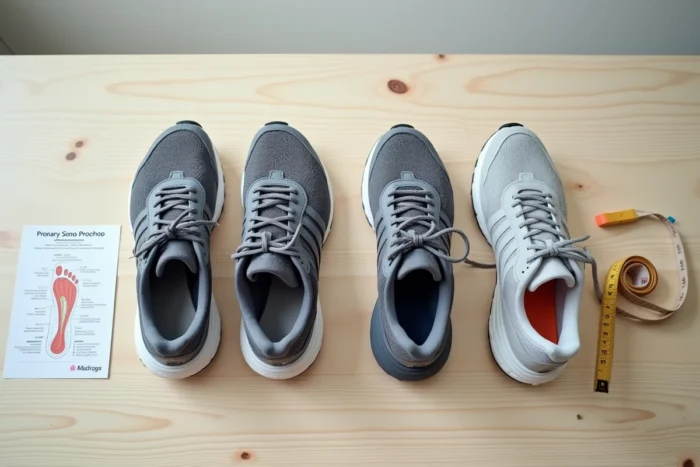
Sole wear is an often-ignored replacement indicator. When the foam of the midsole loses its rebound capacity and the tread pattern of the outsole is worn smooth, the shoe no longer fulfills its role of cushioning or stabilization. Continuing to run with a worn pair negates the benefits of the initial choice, regardless of the stride category.
Practical method for assessing the condition of running shoes
- Place the shoe on a flat surface and observe if it tilts to one side: a visible sag indicates foam deformation.
- Press the midsole with your thumb: if it does not quickly return to its shape, the cushioning is degraded.
- Compare the wear on the inner and outer edges: marked asymmetry confirms the type of stride and indicates that the shoe has compensated as much as it could.
The choice of a running shoe benefits from relying on a range of criteria (comfort, drop, cushioning, terrain, width) rather than solely on the pronation or supination label. Recent biomechanical data point in this direction: the best shoe is the one in which the foot feels stable, not the one designated by a categorization algorithm.