
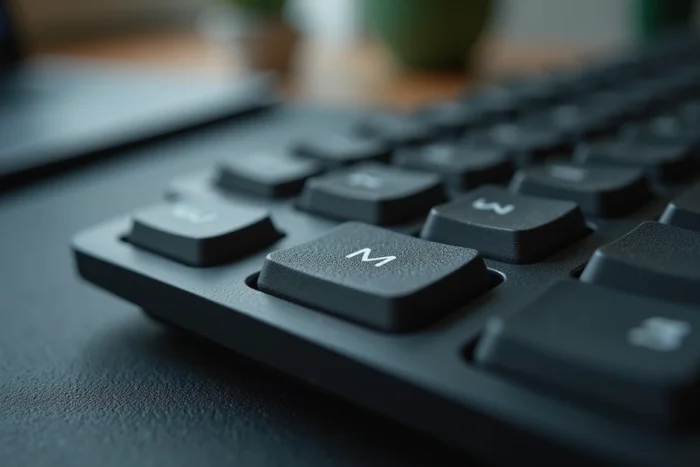
On an AZERTY keyboard, the letter M is located at the bottom right, just after the comma. On a QWERTY keyboard, it changes position. This shift, seemingly trivial, generates frequent typing errors among French speakers who switch from one layout to the other. The position of M on a QWERTY keyboard follows a logic inherited from the English typewriter, and finding it requires understanding this logic rather than fumbling around.
Why the M changes position between AZERTY and QWERTY keyboards
On a French AZERTY keyboard, the M occupies the bottom row, all the way to the right, after the comma and semicolon. On a QWERTY keyboard, the M is on the same bottom row, but next to the letter N, towards the center. The sequence of keys on the bottom row of a standard QWERTY is Z-X-C-V-B-N-M.
This repositioning is explained by the Anglo-Saxon layout, designed for the English language. In English, the most common letter combinations (TH, HE, IN, ER, AN) dictate the placement of the keys. The M, often followed by vowels in English, has been placed in an area accessible to the right index finger.
For a French speaker accustomed to AZERTY, the reflex is to look for the M at the end of the row. On a QWERTY, this gesture leads to the comma or period key, resulting in repeated typing mistakes. Knowing how to type the letter m on a qwerty keyboard starts with visually identifying this new position, between the N and the comma.

Exact position of M on the bottom row of a QWERTY keyboard
The bottom row of a standard QWERTY keyboard (US layout) reads from left to right: Z, X, C, V, B, N, M. Therefore, the M is the seventh and last letter of this row. Right after it come the comma key, the period key, and then the slash key.
In traditional typing, the M is typed with the right index finger. The finger starts from its resting position on the J key (the tactile marker with the small raised bump) and moves down one row to the right.
Tactile markers to locate the M without looking
The small bump on the J key serves as an anchor point. From J, three movements allow you to locate the M:
- From J, move down one row and slightly to the right: that’s the M
- The N is just to the left of the M, accessible with the same right index finger
- The comma key, immediately to the right of the M, is typed with the right middle finger
This method works on the vast majority of standard-sized QWERTY keyboards. On compact keyboards (laptops, keyboards without a numeric keypad), the keys are closer together, but the N-M-comma sequence remains the same.
Non-standard QWERTY keyboards and the relocated M key
Not all keyboards labeled QWERTY place the M in the same spot. On the forum CommentÇaMarche, a user reported in April 2024 that their new laptop had the sequence W-X-C-V-B-N-M, with an M positioned right next to the N, but in a hybrid layout that did not correspond to either the US QWERTY or the French AZERTY.
This type of situation occurs with keyboards sold for specific markets. Some manufacturers deliver laptops with QWERTY layouts adapted to other languages (Portuguese, Spanish, Turkish), where the position of the M remains close to the standard but where other keys change places. The result: even if you find the M, the surrounding keys do not match expectations.
Before changing typing habits, the first step is to identify the exact keyboard layout. In Windows, the setting can be checked in Settings, then Time & Language, then Language & Region. The software layout takes precedence over the physical inscriptions on the keys. A physically marked QWERTY keyboard can function in AZERTY if the operating system is configured that way, and vice versa.
Keyboard shortcuts and access to M on the Windows virtual keyboard
The M does not pose any particular difficulty in terms of shortcuts: the Ctrl+M combination is not universally assigned and varies by software. However, the issue of accessing the M becomes more complicated with virtual keyboards.
On Microsoft Q&A, a documented case described a virtual AZERTY keyboard activated for eye tracking (using a Tobii device) where the letter M was simply absent from the display. This bug, reported on Windows 10, illustrates a concrete problem for users with disabilities who rely on the virtual keyboard.
Switching between QWERTY and AZERTY in Windows
For users who regularly alternate between the two layouts, Windows offers a quick toggle shortcut:
- Alt+Shift (left) allows switching from one layout to the other if multiple input languages are installed
- Win+Space displays the list of available layouts and allows selecting the desired one
- The language bar in the notification area indicates the active layout (FR for AZERTY, EN for QWERTY)
A common trap: accidentally activating QWERTY by pressing Alt+Shift. The M then types correctly, but the letters A, Z, W, and Q become swapped. Checking the active layout before searching for a “missing” key avoids a lot of frustration.
Adapting typing to QWERTY when coming from AZERTY
The transition from an AZERTY keyboard to a QWERTY one is not limited to the M. The letters A and Q, Z and W are also swapped. The M, however, does not change rows but shifts towards the center. This shift is the most confusing because it affects a frequently used key in French.
To acquire the right reflex, the most direct method is to type the sequence “N-M-comma” in a loop for a few minutes. This trio of adjacent keys on the QWERTY anchors muscle memory. The M then ceases to be “lost” and integrates naturally into typing.
Typing training software often offers a dedicated QWERTY mode. A few short sessions focused on the bottom row are enough to reduce errors. The difficulty is not so much finding the M as it is unlearning its old position on the AZERTY.