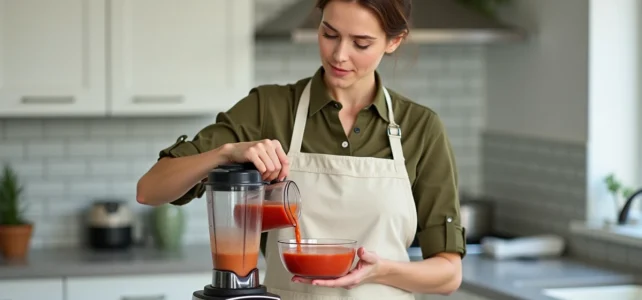
A “Top Chef” blender refers to a type of blender whose features resemble those used in professional kitchens: high-power motor, reinforced blades, large-capacity bowl. The term encompasses a range of devices designed to replicate at home the techniques seen on the show, from ultra-smooth soups to crushed ice in seconds.
Duty cycle and overheating: the criterion that classic guides overlook
Most online comparisons rank blenders by power, capacity, and number of accessories. These criteria matter, but they overlook a technical parameter that makes all the difference between a consumer device and a professional model: the duty cycle, or the duration for which the motor can operate without overheating.
An entry-level blender can run without issue for a thirty-second smoothie. Start it on a series of soups, a puree of dried fruits, then a sorbet, and the motor heats up. The thermal safety feature shuts off the device, sometimes in the middle of operation.
A blender designed for Top Chef use can handle prolonged and repeated operation. It is this endurance that allows for continuous preparation during a Sunday batch cooking session or a meal for several guests without forced interruptions. To compare the best Top Chef blenders on Gourmandises et Cie, this criterion of resistance to intensive use should be checked as a priority.
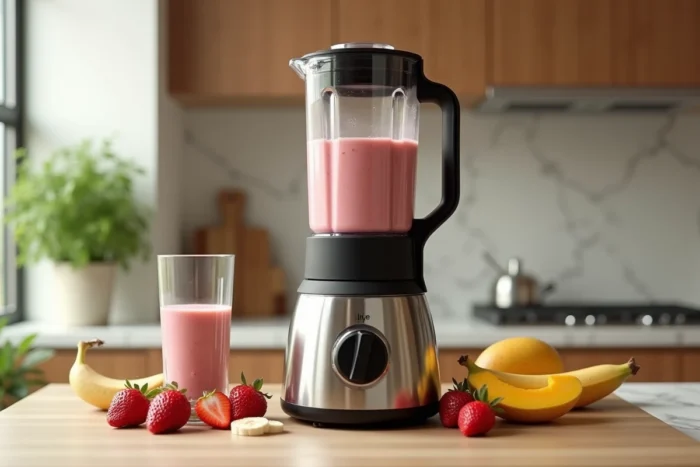
Motor power of a Top Chef blender: beyond the displayed watts
Power in watts is the first figure highlighted on product sheets. A powerful motor crushes hard ingredients (ice cubes, nuts, fibrous raw vegetables) more easily. Recent comparisons of professional blenders recommend aiming for at least 800 W to regularly crush hard ingredients.
But raw power is not enough. Two parameters complement it:
- The quality of the blades: thick stainless steel blades, arranged at multiple levels in the bowl, create a vortex that pulls food back to the center. A blender with flat blades does not produce the same result, even with an identical motor.
- The progressive speed control: being able to start slowly and then increase power avoids splashes and provides precise control over the final texture, from coarse chop to silky smooth.
- The motor torque, rarely indicated but noticeable in use: a device that slows down as soon as hard pieces are added lacks torque, regardless of its nominal wattage.
In summary, the technical sheet of a Top Chef blender is not only read at the “power” line. The actual behavior under load is as important as the displayed figure.
Bowl capacity and materials: adapting the blender to your kitchen
The volume of the bowl directly determines the type of recipes that can be made. Recent comparisons indicate that a bowl of at least 2 liters is recommended when preparing regularly for several people. For a couple without children making a daily smoothie, a 1.5-liter bowl may suffice. For family batch cooking or large quantities of soups, going below 2 liters becomes a constraint.
Tritan, glass, or stainless steel
The material of the bowl influences durability and ease of use. Glass resists scratches and does not retain odors, but it is heavy and breakable. Tritan (high-strength plastic) is lighter and nearly unbreakable, which explains its adoption by many professional-grade manufacturers. Stainless steel, rarer in consumer models, offers excellent thermal resistance but prevents seeing the preparation in progress.
A often overlooked point: the resistance of the bowl to hot liquids. Pouring boiling soup into a low-quality plastic bowl can deform it or release undesirable compounds. Professional-type models generally accept hot preparations without restriction, a direct advantage for replicating recipes from the show.

Top Chef blender and premiumization: should you invest in high-end models?
The market for household blenders is evolving towards devices that are closer to professional models. This trend, driven by the rise of home cooking focused on health and the influence of shows like Top Chef, pushes manufacturers to offer more powerful motors, larger bowls, and better overall durability, even in mid-range lines.
The budget question thus arises differently than a few years ago. A current mid-range model often offers performance that would have fallen into the professional segment before. The performance gap between mid-range and high-end has narrowed, but it remains significant on three points: motor longevity, operational silence, and after-sales service quality.
Investing in a high-end model is justified for intensive daily use. For occasional use (a few smoothies per week, a soup now and then), a mid-range device with a sufficiently powerful motor and a Tritan or glass bowl will do the job without notable compromises on preparation quality.
What makes the difference in use
Beyond specifications, three practical details separate a good blender from a frustrating device: noise level (a powerful motor poorly insulated makes cooking hard to bear), ease of cleaning (a removable dishwasher-safe bowl changes the game), and stability on the countertop. A device that vibrates or moves during blending at full power ends up not being used.
The choice of a Top Chef blender relies less on brand or design than on the match between actual power, resistance to prolonged use, and preparation volume. A device that delivers on these three technical axes will cover almost all recipes, from simple gazpacho to homemade praline.