
The “quirky” sections of major French media compile surprising news stories every day, from a wild feline rescued by hikers in the Pyrénées-Atlantiques to a peanut butter artwork that makes visitors slip in a museum in Rotterdam. These unusual and enchanting news items capture attention, but their effect on the reader goes beyond mere entertainment. A deeper trend, driven by social media and documented by psychological research, is redefining the place of this content.
Whimsy-maxxing: fantasy as a daily well-being strategy
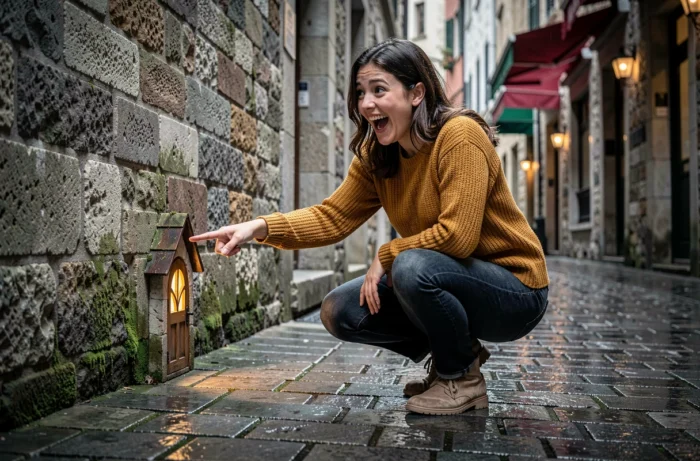
The term “whimsy-maxxing” emerged in English-speaking media around 2026, notably shared by Vice. The principle: to intentionally integrate touches of whimsy, play, and enchantment into one’s daily routine. Childlike decorations at the office, bold colorful outfits, joyful micro-rituals in the morning—everything is good to inject a dose of lightness into days saturated with anxiety-inducing information.
What distinguishes this trend from a mere aesthetic whim is the discourse that accompanies it. Whimsy-maxxing is presented as a deliberate lever for emotional well-being, almost a prescription in the face of an overload of negative news. Followers are not trying to escape reality: they are building deliberate outlets.
The quirky news sections of traditional media (20 Minutes, Ouest-France, Le Figaro) feed this need without ever naming it. They publish stories of rings found after decades, weddings held in flooded churches, and wacky world records. These narratives, compiled daily on the website licorne-cosmique.com, participate in the same mechanism: offering a magical interlude that recharges attention and mood.

Positive content and mental health: what recent research documents
The idea that reading pleasant stories is beneficial is not new. What is newer are the studies published between 2023 and 2025 that quantify this effect.
Several studies show that regular exposure to pleasurable narrative content (fiction, positive stories) is associated with a measurable decrease in stress and better emotional stability, including among adolescents. A meta-analysis from 2025 covering 21 studies further established that increased time spent with storybooks enhances empathy in children.
These results provide a concrete foundation for what enthusiasts of quirky news practice intuitively. Scrolling through a section of strange or enchanting facts is not a waste of time: it is a form of pleasurable reading whose cognitive and emotional benefits are documented.
Limitations to keep in mind
The available data do not allow us to conclude that passive consumption of quirky briefs produces the same effects as prolonged reading of fiction. The format matters. An article of three paragraphs about a lawnmower inspired by Fast and Furious does not engage the same circuits as a novel.
Field feedback also diverges on the threshold at which compulsive seeking of “feel-good” content becomes a form of avoidance. Whimsy-maxxing claims an active and chosen approach, not a reflex of escape.
Enchanted news in France: beyond the news item
The quirky news published by French media in recent weeks illustrates a diversity of registers that goes beyond mere “bizarre”.
- Hikers in the Pyrénées-Atlantiques rescued what they thought was an abandoned kitten, only to discover it was a rare wild feline, one of the last of its kind in the region.
- In the Philippines, a couple maintained their wedding in a completely flooded church, transforming the ceremony into a surreal scene.
- At the Boijmans van Beuningen Museum in Rotterdam, a hexagonal floor of 25 square meters covered in peanut butter, a tribute to artist Wim T. Schippers, caused visitors to slip for two months.
- In Mayenne, a handyman transformed a lawnmower wreck into a racing machine inspired by Fast and Furious, with an official race to boot.
These stories share a common trait: they rely on a discrepancy between the expected and the real that produces a pleasant surprise effect. The wild cat mistaken for a domestic kitten, the enchanting wedding in muddy water, the artwork that makes people fall—each narrative plays on a twist that the reader does not anticipate.
Social media and minors: the regulatory framework affecting dissemination
The circulation of these enchanting contents passes massively through social media, and the French legal framework experienced a significant episode in 2026. The law of August 24, 2026, aimed to prohibit access for minors under 15 to social media. The Constitutional Council censored this provision, deeming it a disproportionate infringement on several fundamental freedoms.
This decision has direct consequences on the dissemination of quirky news to young audiences. Platforms are not required to verify users’ ages according to the provisions of the censored text. Positive content, like harmful content, remains accessible under the same conditions.
For media producing quirky sections, this situation creates a paradox. The studies mentioned earlier suggest that positive narrative content benefits adolescents. However, the environment in which this content is consumed (algorithmic flows, notifications, targeted ads) raises distinct questions that research has not yet resolved.
Quirky news and algorithms: why this content rises to the top
The quirky sections of 20 Minutes, Ouest-France, or franceinfo are among the most consulted sections of these sites. Social media algorithms amplify this phenomenon: content that generates positive emotional reactions (surprise, amusement, tenderness) receives more shares and comments, increasing its visibility.
Whimsy-maxxing fits into this mechanism. Users who share a story of a ring found after 28 years in a lake or a player winning 20,000 euros in the Lotto without having checked a single correct number are not just transmitting information. They signal to their network that they value lightness, which enhances the visibility of this content among similar profiles.
The boundary between quirky news and enchanting content tends to blur. Traditional media borrow the narrative codes of the marvelous (twists, coincidences, comic disproportion) to report real facts. The result increasingly resembles what Anglo-Saxons call “good news,” a distinct editorial genre that does not yet have a stable name in France, but whose demand remains strong.