
A sloped area covered with brambles does not require the same tool as a well-maintained lawn edge. The choice of a brush cutter depends on a few specific technical criteria, often poorly prioritized in traditional guides. Understanding the nature of the vegetation to be cut, the type of engine, and the appropriate cutting system helps avoid an oversized purchase or, worse, an undersized one.
Legal obligation for clearing: a game-changing criterion
Do you live near a forested area? Since decree n° 2024-295 of March 29, 2024, the legal obligation for clearing (LOC) requires individuals to clear their plots to a depth of up to 50 meters around their homes, and up to 200 meters near forested areas. This regulatory constraint radically changes the specifications.
A lightweight trimmer is no longer sufficient when it comes to cutting thick underbrush over large areas multiple times a year. The LOC often requires a more robust machine than the garden’s surface area would suggest. Before consulting technical sheets, check if your municipality is subject to a prefectural order. This directly points towards a blade brush cutter rather than a simple string trimmer.
On debroussailleuse-warrior.com, the models are categorized by use, making it easier to sort between finishing machines and intensive clearing machines.
String, blade, or disc: what cutting system for which vegetation
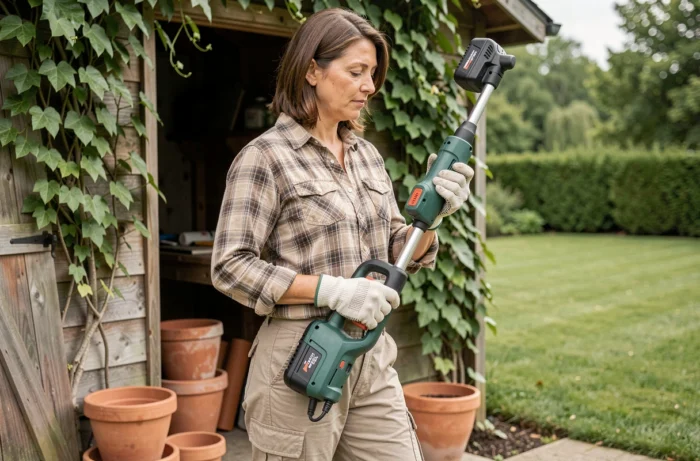
The cutting system is the first criterion to decide, well before the power of the engine. Why? Because a powerful machine equipped with the wrong cutting tool remains ineffective.
Nylon string is suitable for soft grasses and lawn finishing. It works by rapid rotation and easily cuts through tender stems. However, when faced with brambles, woody nettles, or shrub regrowth, the string breaks or wears out in a matter of minutes.
The grass blade (generally three or four teeth) takes over for semi-woody vegetation. It regularly mows dense tall grasses and young bramble shoots.
The toothed disc (circular saw type) tackles thin trunks and thick underbrush. It is suitable for fallow land where the vegetation is several seasons behind.
- Nylon string: lawn finishing, fine grasses, borders along walls and flower beds.
- 3 or 4-tooth blade: tall grasses, young brambles, dense but not woody vegetation.
- Toothed disc: thick underbrush, young shrubs, clearing of fallow land or sloped terrain.
Some models accept all three types of cutting thanks to a universal attachment system. Opt for a versatile machine if your terrain combines lawn and semi-wild areas.
Gas, battery, or electric: choosing the right engine
The engine determines the autonomy, weight, and noise level of the machine. Each technology has a specific usage context.
Gas engine for large areas
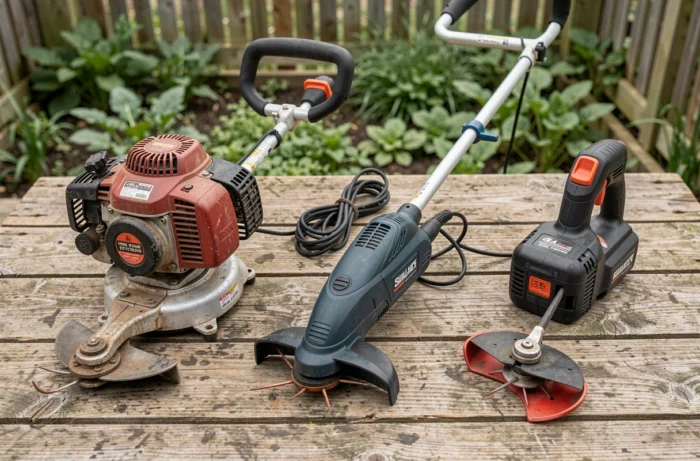
The gasoline engine (two-stroke or four-stroke) offers the highest power and autonomy limited only by the tank. It is the logical choice for large areas or prolonged clearing work in fallow land. The downside: a higher weight, marked vibrations, and regular mechanical maintenance (spark plug, filter, carburetor).
Battery: the evolving compromise
Battery-powered brush cutters (18 V to 54 V) have gained credibility in recent years. The global market for these machines was valued at $157 million in 2024, with an annual growth rate projected at around 3.6% until 2031. In Europe, demand is driven by noise and emission regulations.
The battery is suitable for medium-sized gardens with moderate vegetation. Autonomy remains the weak point: expect one to two recharges for demanding terrain. Having a spare battery partially solves the problem.
Wired electric: limited but lightweight
Plugged into an outlet, this type of machine is lightweight and requires almost no maintenance. The constraint of the cord limits its use to the immediate vicinity of the house. For lawn edges on a small plot, this is sufficient.
Comfort of use: harness and handle, the details that matter
Have you ever spent an hour clearing with a poorly balanced machine? Muscle fatigue sets in quickly, especially in the shoulders and back. Two elements make a difference in daily use.
The harness distributes the weight of the machine across the chest and hips. A double strap model (forestry type) is preferable as soon as the machine exceeds a few kilos. Single strap harnesses are suitable for lightweight trimmers, not for clearing machines.
The choice between a handlebar and a loop handle depends on the cutting movement. The handlebar (U-shaped) allows for a wide sweep, ideal for mowing open areas. The loop handle offers more maneuverability in cluttered areas, slopes, and corners.
- Handlebar: open areas, mowing tall grasses, flat or slightly uneven terrain.
- Loop handle: slopes, underbrush, contours of trees and flower beds.
- Double strap harness: recommended as soon as the session exceeds 20 to 30 minutes.
Noise regulations: a parameter to check before purchase
In France, the use of powered gardening tools is regulated by municipal orders. The authorized time slots vary from one municipality to another, but gas brush cutters, often noisy, reduce the possible usage window.
Battery models emit significantly less noise than gas models, allowing work during wider time slots without risking neighborhood conflicts. The European directive on noise emissions from outdoor equipment pushes manufacturers to reduce decibel levels, a movement that accelerates the adoption of electric engines.
If your terrain is in a dense residential area, the battery offers a concrete advantage beyond just the ecological question. Check your municipality’s orders before making your choice, especially if you plan frequent clearing sessions on weekends.