
A particle board furniture does not behave like solid wood furniture that has been oiled. The emissions of volatile organic compounds vary depending on the binder, the finish, and the volume of exposed material. Adjusting the ventilation duration to the exact profile of the furniture avoids both excessive caution and underestimating the actual risk.
REACH restriction on formaldehyde: what changes for the ventilation of new furniture
Since August 6, 2026, the European REACH regulation imposes a formaldehyde emission limit of 0.062 mg/m³ for all furniture and wood-based products marketed in the European Union. This value, measured in a standardized test chamber, constitutes the first uniform binding standard at the European market level.
In practical terms, furniture compliant with this restriction has a significantly lower initial emission profile than older E2 classified boards. The peak of VOCs upon unpacking is still present, but its intensity decreases. We observe that the duration of intensive ventilation required is reduced for furniture compliant with the REACH standard, compared to products manufactured before the enforcement of this restriction.
This regulatory evolution does not exempt from ventilating. It shortens the critical window. To know precisely how long to ventilate an Ikea piece of furniture or any other furniture made of particle board, one must cross-reference the product’s regulatory compliance with the actual conditions of the room.
Ventilation duration according to panel type and finish
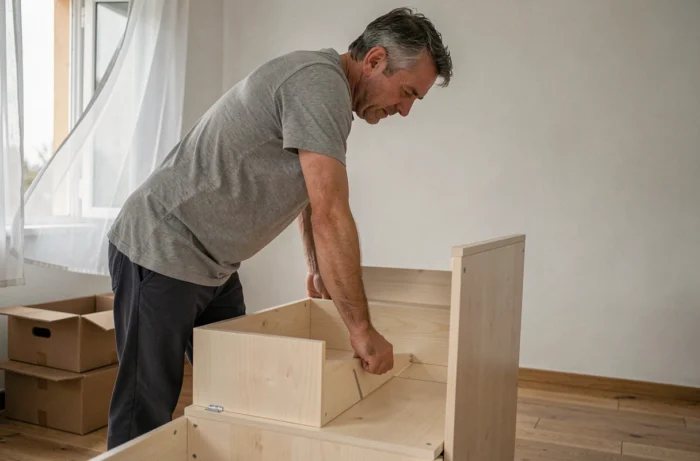
Not all new furniture emits the same substances, nor in the same proportions. The determining factor is not the brand, but the nature of the panel and its surface treatment.
Particle boards and melamine MDF
Particle boards and MDF use urea-formaldehyde resins as a binder. They are the main emitters of formaldehyde indoors. Formaldehyde emissions from particle boards can persist for several weeks to several months, with a peak concentrated in the first few days after unpacking.
A piece of furniture with all surfaces covered in melamine emits less than a raw panel, as the coating acts as a barrier. Uncoated edges, screw holes, and uncovered cuts are leakage points where emissions remain active longer.
Solid wood and plywood
Solid wood does not emit formaldehyde related to glues, but it can release natural VOCs (terpenes, especially in conifers). These compounds dissipate more quickly. Plywood, bonded with phenolic or melamine resin, falls between solid wood and particle board in terms of emission duration.
Varnished, lacquered, or painted furniture
Solvent-based finishes add an additional layer of VOCs to the off-gassing of the panel. A new lacquered piece of furniture accumulates emissions from both the substrate and the finish. Water-based paints and varnishes reduce this overload but do not eliminate it entirely.
Ventilation and temperature: the two levers that accelerate off-gassing
The duration of ventilation is not only counted in days. It directly depends on the conditions in which the furniture is placed.
- Temperature accelerates the off-gassing of VOCs. A room heated to normal ambient temperature promotes faster emission than a cold garage. Placing the furniture in a temperate and well-ventilated room during the first few days concentrates the emission peak over a shorter period.
- Air renewal is the most effective factor. Opening windows to create a draft through the room evacuates VOCs instead of slowly diluting them. A continuously operating mechanical ventilation system complements this setup, especially at night when the windows are closed.
- Relative humidity plays a secondary but real role. A high humidity level can slow the evaporation of certain solvents while promoting the hydrolysis of resins, which keeps formaldehyde emissions low for longer.
Room by room: adapting the ventilation strategy to volume and use
We recommend not applying the same ventilation duration to a living room piece of furniture and a child’s bedroom dresser. The volume of the room, the exposure time of the occupants, and their sensitivity modify the level of precaution necessary.
Child’s room and bedroom
A bedroom is a room where one spends several consecutive hours, often with windows closed. A new piece of furniture in a child’s room deserves prolonged ventilation of at least several days, ideally in another ventilated room before installation. Young children are more sensitive to indoor pollutants than adults.
Living rooms and offices
A living room or office generally benefits from a larger air volume and more frequent openings. The natural dilution of VOCs is better there. The ventilation duration can be reduced, provided that daily ventilation is effective.
Windowless rooms
A dressing room or closet integrated into a windowless room poses a specific problem. Without natural air renewal, VOCs accumulate. The mechanical ventilation system then becomes the only ventilation lever. Keeping the furniture doors open at all times during the first few weeks remains the minimum precaution.
Labeling and VOC labels: read before buying to ventilate less
Labeling of indoor air emissions, mandatory in France for construction and decoration products, classifies products from A+ (very low emissions) to C (high emissions). A piece of furniture labeled A+ requires a significantly shorter ventilation duration than a product classified B or C.
Several complementary labels allow for identifying low-emission furniture before purchase:
- The French A+ label on the regulatory indoor air emissions labeling covers formaldehyde and several other VOCs.
- Compliance with the REACH restriction entry 77, verifiable with the manufacturer, guarantees adherence to the limit of 0.062 mg/m³ for formaldehyde.
- Voluntary certifications such as NF Environment Furniture impose stricter emission thresholds than the basic regulation.
Choosing low-emission furniture in advance remains the most effective strategy to reduce the necessary ventilation duration. A panel classified E1 or E0.5, covered on all sides, in a properly ventilated room, reaches a negligible emission level more quickly than a low-end panel without clear labeling.
The ventilation duration of new furniture is not a fixed number applicable to all cases. It results from the intersection of the panel quality, its finish, the room volume, and the actual ventilation of the home. Checking the labeling before purchase and prioritizing the first hours of intensive ventilation after unpacking remains, in all cases, the basis for good management of indoor pollution.