When migrating a team of five people to a free office suite, the first friction is not technical. It’s the Excel file loaded with VBA macros that a colleague refuses to open in LibreOffice. This kind of concrete situation reveals what it truly means to adopt free software on a daily basis, far beyond the discourse on values.
Lock-in by proprietary formats: the real starting point
Most organizations do not choose software; they inherit a format. .docx, .pptx, or .psd files circulate between departments, and each opening in a third-party tool generates micro-losses in formatting. This lock-in by format is the main lever for proprietary publishers to retain their users.
Switching to free software is primarily about regaining control over formats. Suites like LibreOffice use the ODF (Open Document Format), standardized by ISO. Any compatible software can read and modify these files without depending on a single publisher. This logic is reflected in the resources published by Monde Libre, which document tools and practices that promote interoperability.
In practical terms, a local authority that stores its deliberations in ODF is not trapped ten years later because a publisher has changed its pricing policy. The open format protects access to data in the long term.
Accessible source code: what it changes for security and trust
With proprietary software, no one outside the publisher can verify what the program actually does with the data. We trust a black box. With free software, the source code is readable by everyone. Any developer can audit it, spot a vulnerability, or report suspicious behavior.
This transparency is not just a philosophical principle. The European regulation Cyber Resilience Act (CRA), regulation (EU) 2024/2847 that came into effect in December 2024, created a legal status of “open source software steward”. This status recognizes the foundations and associations that maintain free software used in commercial products, with a lighter obligation regime compared to traditional publishers.
This legal framework reflects a ground reality: entire segments of digital infrastructure rely on free components maintained by communities. The CRA also imposes, since September 2026, reporting obligations for security vulnerabilities for free components integrated into commercial offerings. The transparency of the source code facilitates this reporting, where closed software slows down the process.
Free software and digital sobriety: a concrete link
Ethics in free software is often discussed from the perspective of user freedoms. The environmental angle deserves equal attention. A free operating system like a GNU/Linux distribution runs on older hardware that Windows no longer supports. The lifespan of a workstation can be extended by several years simply by changing the system.
This is not trivial. The workstation represents a significant part of the carbon footprint of a computer park, and manufacturing weighs much more than usage. Here are the concrete levers that free software offers in this area:
- Light distributions (Lubuntu, Xubuntu, antiX) can run machines over ten years old for office tasks and web browsing.
- The absence of intrusive telemetry reduces unnecessary network traffic and background CPU usage.
- No planned software obsolescence: no forced updates make hardware incompatible overnight.
Feedback varies depending on hardware configurations, but in a homogeneous park of office workstations, migrating to Linux measurably extends the useful life of the hardware.
Governance and free licenses: what we really accept when clicking “I accept”
Installing proprietary software means accepting a license that no one reads. These contracts often allow for the collection of usage data, unilateral modification of terms, or the prohibition of reselling or lending the software. We own nothing; we rent a revocable access right.
Free licenses work in the opposite way. A GPL or AGPL license guarantees four freedoms: to run the program, to study how it works, to redistribute copies, and to distribute modified versions. The copyleft mechanism adds a clause: any derived version must retain these same freedoms.
For an organization, this means:
- No contractual dependency on a single vendor for software maintenance or evolution.
- The ability to have the code audited, adapted, or corrected by the provider of their choice.
- A total transparency on the processing of user data, verifiable in the source code.
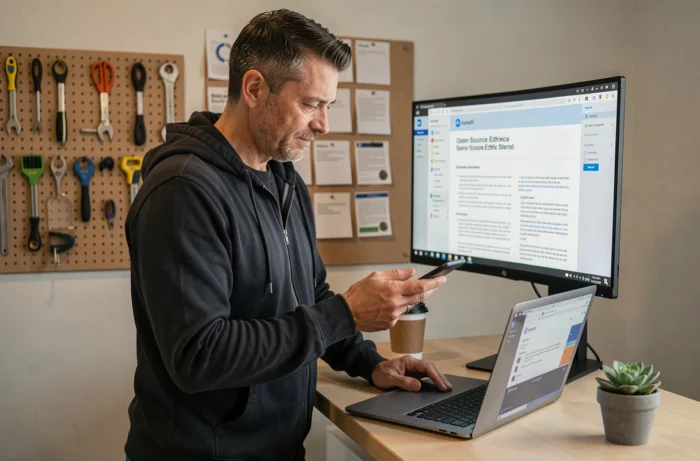
This model of software governance redistributes power. The user is no longer a passive consumer of a service; they become a stakeholder in an ecosystem where the rules are readable and shared.
Migrating to free software: the real barriers to anticipate
Adopting free software is not just about installing Firefox and LibreOffice. The main obstacle remains compatibility with the existing environment. If partners, clients, or administrations require proprietary formats, one ends up juggling between two worlds.
Training is another often underestimated aspect. Interfaces differ, reflexes change. A Calc spreadsheet is not manipulated exactly like Excel, even if the basic functions are identical. Planning for change management avoids silent rejections.
Technical support is also a concern. With proprietary software, you call a number. With free software, you consult community documentation, post on a forum, or contract with a specialized provider. Both models work, but they require different habits.
Choosing free software for a more ethical and responsible IT is not a symbolic gesture. It is a technical, organizational, and budgetary decision that impacts file formats, data security, hardware longevity, and the governance of digital tools. The recent European regulatory framework, with the Cyber Resilience Act, reinforces the legitimacy of this choice by officially recognizing the role of free communities in the software ecosystem.