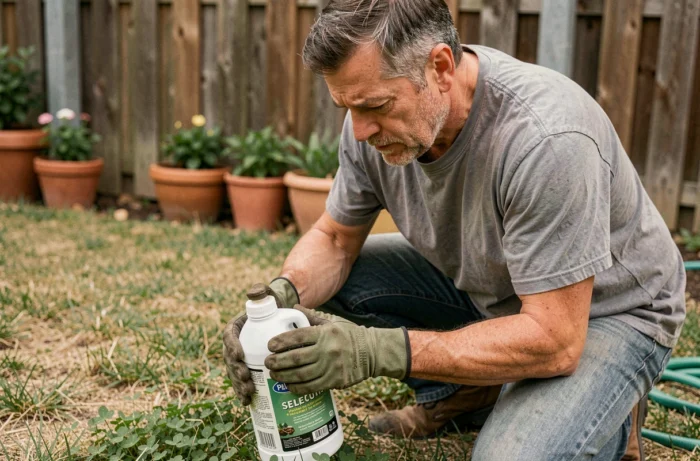
Your lawn is overrun with dandelions and clover, but you don’t want to mow it all down. Selective lawn treatment targets unwanted plants without damaging the grass. However, you need to choose an approved product, dose it correctly, and apply it at the right time. This guide details each step to achieve a clean result from the first application.
Check the legality of the product before any application on the lawn
Before discussing dosage or spraying, one preliminary question arises: are you allowed to use this product? Since 2019, classic synthetic selective herbicides have no longer been available to individuals in France.
Only biocontrol products, low-risk products, or those approved for organic farming remain legal for domestic use. Look for the EAJ (authorized for use in gardens) mention on the label. Without this mention, the product exposes you to a fine.
Since July 1, 2022, the ban also covers the outdoor spaces of private properties used for residential purposes. And since January 1, 2025, it has extended to large play areas and grass tennis courts. If you maintain a sports field, the regulatory framework has thus changed recently.
For green space professionals with a valid Certiphyto, synthetic products remain usable within a regulated framework. In any case, checking the product’s compliance is the first step, even before taking out the sprayer. All details on the dosage praixone on Agri Systems complement this verification usefully.
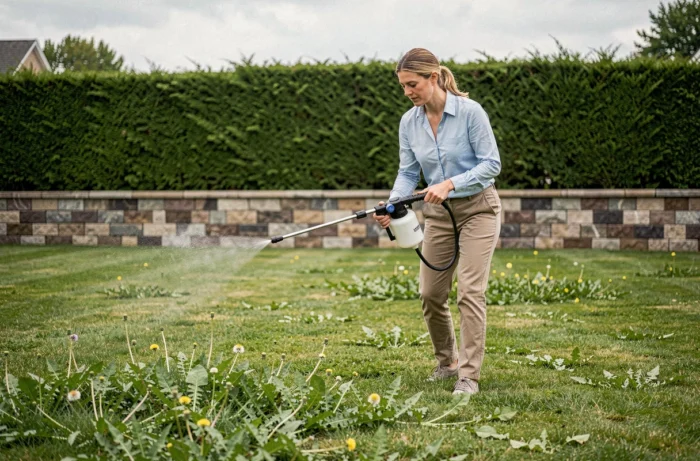
Weather conditions and lawn state: two criteria that change everything
Have you ever noticed that a treatment applied in hot and dry weather seems less effective? It’s not just an impression. The weather directly affects the absorption of the product by the leaves of the weeds.
Ideal temperature and humidity
The soil should be slightly moist, but not waterlogged. Apply the treatment when the temperature is between 10 and 25 degrees, ideally in spring or early autumn. Above 25 degrees, the product evaporates too quickly, and the weeds absorb less active substance.
Avoid windy days as well. The wind disperses droplets onto neighboring beds, hedges, or the vegetable garden, which negates the selectivity of the treatment.
Mow before, not after
Mow the lawn three to four days before application. The weeds need to have sufficiently developed leaves to capture the product. Mowing just before reduces the leaf area and decreases effectiveness.
After treatment, wait at least a week before mowing. The product needs time to migrate from the leaves to the roots of the targeted plants.
Preparation of equipment and dosage of selective treatment
The pressure sprayer remains the most suitable tool for a medium-sized lawn. It allows for even distribution of the product, unlike a watering can, which delivers uneven flows.
- Clean the sprayer before each use, especially if it has been used for another product. Residues from a total herbicide would destroy your lawn.
- Set the nozzle to a fine and wide spray (type “fan”) rather than a concentrated jet. This prevents saturating some areas and underdosing others.
- Strictly adhere to the dosage indicated on the product label. Overdosing does not enhance effectiveness and can burn the lawn.
- Prepare only the necessary amount for the area to be treated. Diluted leftovers lose their effectiveness and pose a disposal problem.
To measure the area of your lawn, count your steps along the length and width. An average step corresponds to about 70 centimeters. This approximate calculation is sufficient to adjust the volume of the mixture.
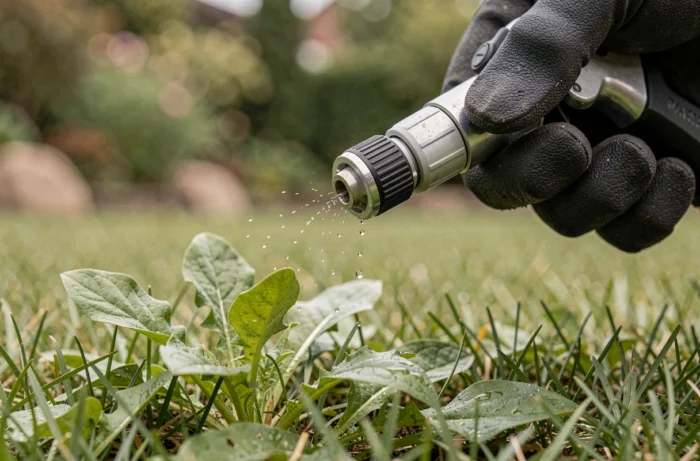
Application technique on the ground: the gestures that matter
Once the sprayer is loaded and the weather is favorable, the method of application makes the difference between a uniform result and forgotten areas.
Treat in parallel strips
Move in straight parallel lines, as if mowing. Each strip should overlap the previous one by a few centimeters to avoid untreated “streaks.” Keep the lance at knee height, about 30 centimeters off the ground.
Walk at a steady pace. Slowing down doubles the local dosage, while speeding up halves it. Consistency is more important than speed.
Sensitive areas and edges
Near flower beds, hedges, or the vegetable garden, reduce the pressure of the sprayer. Some gardeners use a rigid cardboard as a mobile screen to protect nearby plants during spraying.
The edges of the lawn along paths or terraces deserve targeted treatment. Weeds are often denser there due to the heat radiated by mineral surfaces.
After the selective lawn treatment: follow-up and common mistakes
Weeds do not disappear immediately. Expect one to three weeks to observe yellowing and then the death of the targeted plants. Do not retreat before this period, even if the result seems slow.
If rain occurs in the hours following the application, the product is washed away before it has penetrated the leaves. That’s why checking the weather for two days is a reflex to adopt.
- Water the lawn normally starting the next day, unless the product label specifies a longer delay.
- Do not sow grass for reseeding before four to six weeks. Residual product in the soil can block the germination of new seeds.
- Note the date and product used in a notebook. In case of persistent weeds, this record allows for adjusting the next treatment or changing the active substance.
The most common mistake remains treating in too hot weather or on freshly mowed grass. These two combined factors explain the majority of failures reported by amateur gardeners. Good timing is better than a more expensive product.
Selective lawn treatment is not complicated when you follow the sequence: legal verification of the product, favorable weather conditions, precise dosage, regular application in strips, and then patience during the action phase. The lawn naturally thickens once freed from the competition of weeds, provided you give it time to reclaim its place.