
When it comes to automating the sorting of customer tickets, the technology used is not the same as that for generating product sheets or anticipating machine failures. Each family of artificial intelligence addresses a specific operational problem, and confusing their scopes wastes time and budget.
Choosing the right type of AI according to the business problem to solve
The first question to ask is not “which AI is the most effective,” but “which process are we looking to improve?” A logistics service aiming to reduce stockouts needs predictive AI capable of leveraging historical data. A marketing team producing dozens of product descriptions each week will lean towards generative AI. A support center handling complex requests autonomously will look towards agentic AI.
This principle is reflected in how Insee categorizes AI usage in businesses: rather than discussing broad theoretical families, the institute distinguishes eight concrete technologies (text mining, speech recognition, content generation, machine learning, decision support, among others). This functional business perspective is much more useful than an academic classification when it comes to making investment decisions.
To explore the different types of AI from the perspective of their technical specifics, this framing by operational need remains the most reliable starting point.
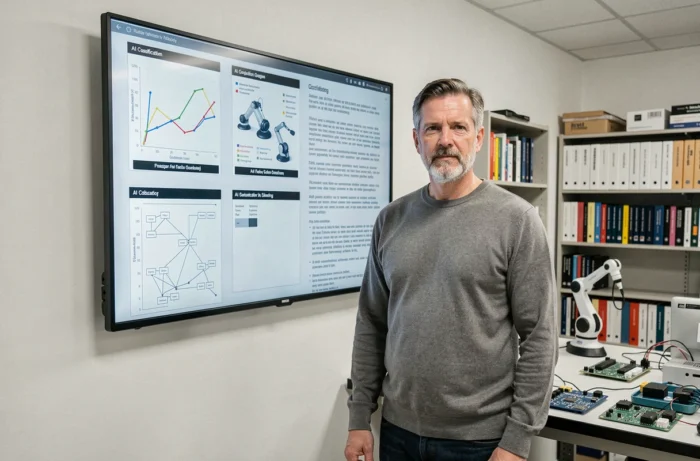
Predictive AI and machine learning: anticipating rather than reacting
On the ground, machine learning remains the most deployed component. Its principle: we feed a model with structured data (sales history, sensor readings, production logs), and it learns to identify recurring patterns to anticipate what will happen.
The most documented use cases revolve around industrial maintenance, fraud detection in finance, and demand forecasting in logistics. In each of these scenarios, the model identifies weak signals before a problem arises.
Deep learning takes this logic further by processing unstructured data: images, sounds, free text. It is found in visual defect recognition on a production line or in the automatic analysis of contractual documents. The difference with traditional machine learning lies in the depth of the neural network and the volume of data needed to train it.
Concrete limitations to anticipate
- A predictive model is only reliable if the training data reflects the current reality of the process. A change in supplier or seasonality can degrade results unexpectedly.
- Deep learning requires computing power and data volume that not all organizations can mobilize. For an SME, a well-calibrated traditional machine learning model often meets the need.
- Feedback varies on the time required for development: between the functional prototype and the stabilized production model, the timeline heavily depends on the quality of available data.
Generative AI: producing content at scale
Generative AI creates new content (text, images, code) from language models trained on vast corpora. It is the technology behind writing assistants, visual generators, and code completion tools.
In business, it is primarily seen in three areas: text generation for customer support and marketing, producing summaries from internal documents, and assisting in software development. Insee confirms that text and speech generation are among the most reported AI uses by French companies, marking a clear shift towards language technologies.
The main limitation remains output control. A generative model can produce plausible but false information. In a process where data reliability is critical (regulatory, medical, financial), systematic human review remains essential.

Agentic AI: delegating complete processes
Agentic AI represents an additional level. While generative AI produces content on demand, an AI agent can reason, plan a sequence of actions, and execute them autonomously. We move from a one-off response to managing an end-to-end process.
The most advanced use cases involve automated claims processing in insurance, dynamic stock optimization in a supply chain, or resolving complex support tickets without human intervention. The agent breaks down the problem, queries multiple data sources, makes intermediate decisions, and delivers a final result.
What distinguishes an agent from a simple chatbot
A generative chatbot answers a question. An AI agent orchestrates several steps to achieve a defined goal. For example, a recruitment agent can analyze a pool of candidates, match profiles with job criteria, pre-draft a personalized message, and schedule interviews, whereas a chatbot would simply respond to a question about the status of an application.
This autonomy raises governance questions: who validates intermediate decisions, how do we audit the agent’s reasoning, what safeguards do we put in place? In high-stakes processes, most current deployments retain human validation at critical steps.
Criteria for choosing between predictive, generative, and agentic AI
Rather than a theoretical grid, we can reason through three practical questions:
- The need concerns anticipating a future event (breakdown, fraud, demand spike): orientation towards machine learning or deep learning, depending on the nature of the data.
- The need concerns content production or assistance in writing, coding, or summarizing: orientation towards generative AI, with a validation circuit adapted to the level of risk.
- The need concerns automating a complete process involving several chained decisions: orientation towards agentic AI, with clear governance on human control points.
These three families are not mutually exclusive. A system can combine a predictive model to detect an anomaly, a generative module to draft the incident report, and an agent to trigger the correction procedure. The value comes from the articulation between these components, not from choosing just one.
The most common pitfall is starting from the technology rather than the problem. One chooses a generative tool because it is well-publicized, while the real bottleneck in the process calls for predictive analysis. Returning to the business need before selecting the technical component avoids this type of mismatch.