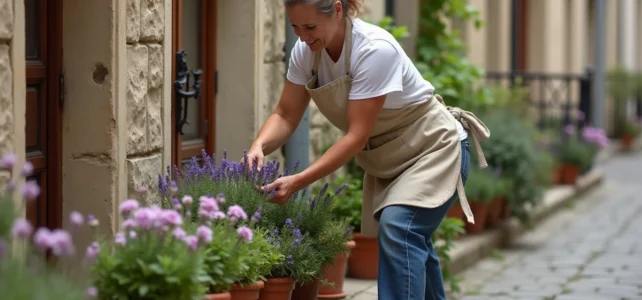
Placing a planter or a flower pot in front of your façade may seem trivial, but the sidewalk is legally a part of the communal public domain. The question is therefore measured against three variables: the legal status of the land, the type of authorization required by the town hall, and the accessibility constraints that determine the feasibility of the project.
Public domain and sidewalk occupation: the legal framework in France
The sidewalk, even if located right in front of your door, belongs to the municipality. The General Code of Property of Public Persons classifies roads and their dependencies (sidewalks, gutters, tree pits) in the public road domain. Any private occupation of this space requires prior authorization from the mayor.
Without this authorization, installing a planter, pot, or flower box constitutes an irregular occupation. The municipality may require the immediate removal of the objects and, if necessary, draw up a report. Before questioning the choice of plants, the first step is therefore to check if your municipality offers an appropriate authorization system, as whether you can place flower pots on the sidewalk entirely depends on the local regulations in force.
Planting permit and municipal order: comparison of systems
Not all municipalities manage sidewalk greening in the same way. Two main mechanisms coexist, with distinct requirements.
| Criterion | Planting Permit | Temporary Municipal Order |
|---|---|---|
| Concerned municipalities | Large cities and metropolitan areas (Paris, Lyon, Toulouse, etc.) | Medium and rural municipalities |
| Procedure | Online form or at the town hall, charter to sign | Written request to the mayor, case-by-case assessment |
| Validity period | Renewable each year or unlimited as long as the charter is respected | Variable, often linked to a specific project |
| Accessibility constraints | Minimum free passage required (often 1.40 m) | Case-by-case assessment |
| List of plants | Authorized or prohibited plants specified in the charter | Rarely detailed |
| Maintenance | At the applicant’s expense, municipal control possible | At the applicant’s expense |
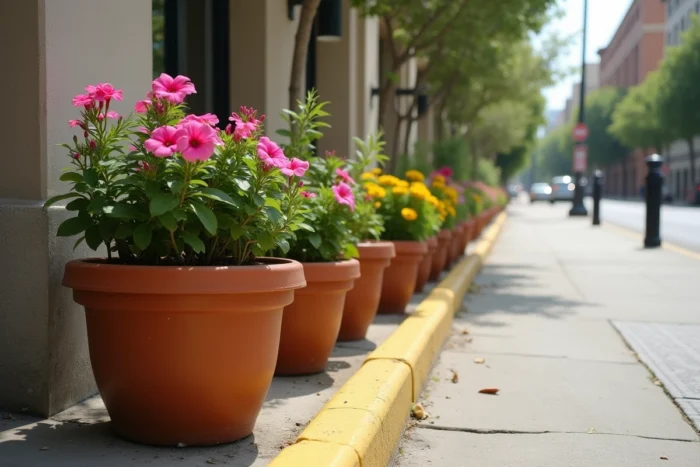
Cities with a planting permit regulate usage more strictly but provide a clear framework. Conversely, in municipalities without a formalized system, the absence of a written response from the mayor does not equate to tacit authorization.
Free pedestrian passage and accessibility for people with reduced mobility: the constraint that blocks most projects
This is the point that most individuals underestimate. Recent greening charters, adopted since 2022-2023 by many central cities, directly incorporate accessibility standards from the Building and Housing Code. The key figure to remember: 1.40 m of minimum free passage on the sidewalk, even in the presence of planters or plantings.
This width ensures the passage of a wheelchair or a double stroller. On a narrow sidewalk of less than two meters, placing a pot with a diameter of 40 cm is enough to make the passage non-compliant. In contrast, on a wide sidewalk, several planters can coexist without difficulty, provided this circulation space is respected.
Failure to comply with this rule exposes you to two risks:
- Removal imposed by the town hall, with restoration of the sidewalk at the individual’s expense if any damage is found.
- The civil liability of the property owner in case of a pedestrian falling or harm caused to a person with reduced mobility, as the occupation was irregular or non-compliant with the issued authorization.
- A fine for illegal occupation of the public domain, the amount of which varies according to the applicable municipal order.
Prohibited plants, maximum height, and maintenance: the rules of municipal charters
Planting permits are not limited to a simple authorization to occupy the sidewalk. Municipalities like Le Vigan, in their orders “My Flowers in the Street,” specify rules that many property owners are unaware of.
Some plants are explicitly prohibited: invasive species, thorny plants extending onto the passage, allergenic plants in certain urban contexts. The charters also impose maximum heights to avoid obscuring road signage or obstructing visibility at intersections.
Maintenance remains entirely the responsibility of the applicant. This includes watering, pruning, weeding, and replacing dead plants. A neglected planter can justify the withdrawal of the planting permit by the municipality, without prior notice in certain regulations.
- Favor drought-resistant and low-maintenance species (sedums, lavenders, low grasses).
- Avoid uncontrolled climbing plants that can damage neighboring facades or urban furniture.
- Ensure that containers are stable and weighted to withstand the wind, as a pot overturned on public property engages your liability.
Insurance and civil liability: what your home insurance covers
Installing plants on public land creates an additional zone of responsibility for the property owner. In case of an incident (a pedestrian falling on a pot, injury caused by a branch, water damage related to watering), it is the civil liability guarantee of your home insurance that will be called upon.
Check with your insurer that your contract covers damages caused by objects placed in public space. Some contracts explicitly exclude claims related to unauthorized occupation of public land. The municipal authorization then becomes a document to keep carefully, as it conditions coverage by the insurance.
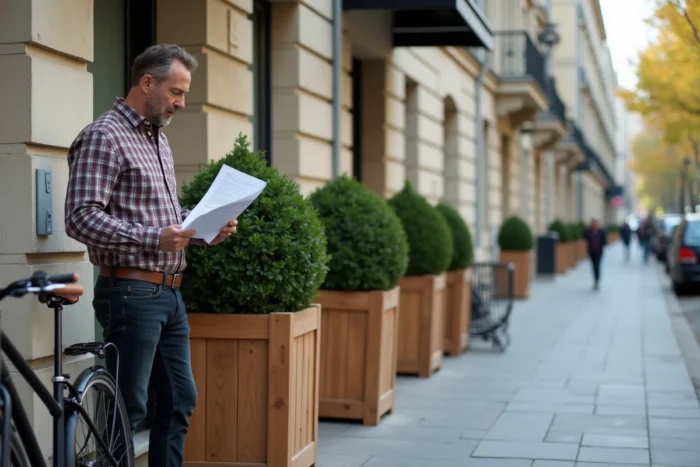
The sidewalk in front of your home remains a public space, regardless of the feeling of proximity. The feasibility of a greening project hinges on three specific points: the existence of an authorization system in your municipality, compliance with the free passage of 1.40 m for accessibility, and the compliance of your home insurance. Checking these three elements before purchasing any pot avoids administrative and financial setbacks.