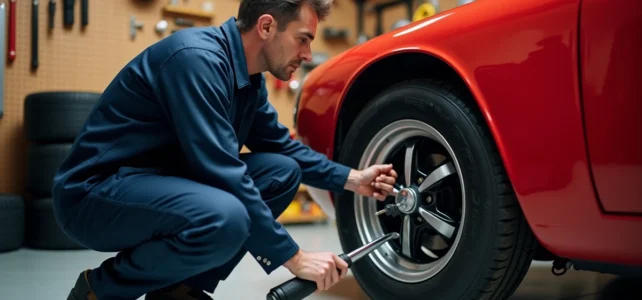
A check engine light coming on while driving at 130 km/h on the highway, a flat tire noticed too late before a long trip, a battery dying on a January morning: most automotive troubles share a common point. They could have been anticipated with a few simple reflexes. This article gathers practical advice for car enthusiasts who want to go beyond just the annual oil change and adopt a preventive approach to car maintenance.
OBD Diagnosis: The Preventive Maintenance Tool That Few Enthusiasts Utilize
We often think of visual checks (oil level, brake pad condition, tire wear). This is the basics, and it’s good. The problem is that some anomalies are not visible to the naked eye: a worn lambda sensor, an intermittent misfire, a temperature probe that drifts.
An OBD reader connected to the vehicle’s diagnostic port allows you to read fault codes before they trigger a warning light. You can find devices compatible with most cars at a modest price, and the associated mobile apps translate the codes into understandable language.
An OBD check every two to three months identifies anomalies before a breakdown. Feedback on the reliability of entry-level devices varies, but even a basic model is sufficient to detect a fault recorded in the ECU. To explore other automotive-related topics, interesting insights can be found in Team Auto Passion’s articles that cover a wide range of practical issues.
The idea is not to replace the mechanic but to arrive with precise information. We shift from the logic of “I repair when it breaks” to “I monitor to avoid breaking.”

Car Maintenance for Electric and Hybrid Vehicles
For a conventional thermal vehicle, we know what to do: oil change, filters, timing belt. For a hybrid or electric vehicle, the reflexes change. The electric motor doesn’t need an oil change, but other components require specific attention.
Traction Battery and Charging Habits
The high-voltage battery is the most expensive component of an electric vehicle. Maintaining the charge level between 20 and 80% daily preserves its longevity. Charging to 100% is useful before a long trip, but making it a daily habit accelerates cell degradation.
On plug-in hybrids, we often see owners who never plug in their vehicle and only drive in thermal mode. The electric motor doesn’t wear out from lack of use, but the traction battery degrades if it stays at a very low charge level for too long.
Regenerative Braking and Brake Pad Wear
On an electrified vehicle, regenerative braking slows the car by recovering energy. Brake pads therefore wear out much more slowly than on a thermal vehicle. This is an economic advantage, but it creates a trap: underused pads can glaze or corrode. It is recommended to brake firmly from time to time to clean the discs.
Connected Eco-Driving: Going Beyond Basic Advice
“Accelerate gently, anticipate braking”: we know the drill. These tips remain valid, but onboard tools now allow for further reductions in fuel consumption.
- Connected driving apps analyze each trip and assign an efficiency score. This helps identify costly habits (sudden accelerations after a stoplight, excessively high engine revs in the city).
- Instant consumption indicators, present on most recent dashboards, allow for real-time adjustments to driving rather than just noticing the damage at the pump.
- Some GPS devices now include optimized route suggestions not only based on time but also on elevation and traffic flow, two parameters that directly affect consumption.
Eco-driving is not about driving slowly. It’s an active reading of vehicle data to adapt driving to the terrain, traffic, and type of engine.

Preparing for a Long Drive: The Checks That Really Matter
Before a vacation departure or a road trip, we see endless lists of things to check. In practice, a few targeted checks are enough to cover most risks of breakdown on the road.
- Tire pressure when cold, including the spare tire (often forgotten, often flat). Insufficient pressure increases consumption and degrades handling.
- Coolant level: on the highway in summer, an engine heats up more. A low level can lead to rapid overheating.
- Condition of wipers and washer fluid level: a detail, until you find yourself behind a truck in the rain with zero visibility.
- Complete lighting check (low beams, turn signals, reverse lights): we almost never check our bulbs, and a burnt-out bulb easily goes unnoticed in daily life.
Each check takes less than five minutes but can prevent several hours of breakdown assistance. We’re not talking about advanced mechanics: a glance at the dashboard, a walk around the vehicle, a pressure measurement with a gauge.
Car Insurance and Mechanical Coverage: An Often Overlooked Angle by Enthusiasts
We invest time and money in maintenance, quality parts, and sometimes technical upgrades. But the car insurance contract often remains the one taken out at the time of vehicle purchase, without review.
Some guarantees cover mechanical failures outside of accidents, while others do not. For a vehicle over five years old or a model with a specific engine (turbo, hybrid), the difference in coverage between two contracts can represent a significant amount in the event of a mechanical claim.
Reviewing your insurance contract once a year allows you to check that the coverage still matches the actual use of the vehicle and its level of equipment. An enthusiast who regularly drives or owns a modified vehicle has every interest in comparing assistance and mechanical warranty options.
Ultimately, taking care of your car is not just about following the manufacturer’s maintenance schedule. Diagnostic tools, the specifics of electrified engines, real-time driving data, and even reviewing an insurance contract are all part of comprehensive car maintenance. It’s these often simple reflexes that separate a reliable vehicle from one that breaks down at the wrong moment.