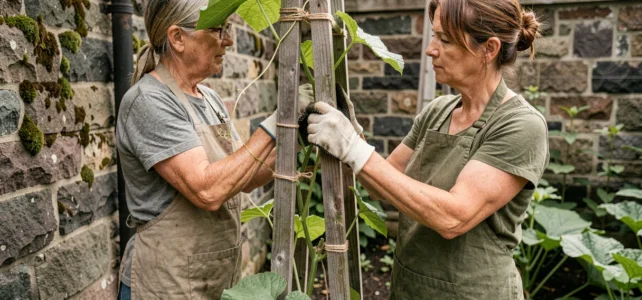
Growing butternut squash in a small garden raises a question of yield per square meter. In a sprawling culture, a single plant easily occupies several square meters of ground for a sometimes disappointing harvest. Vertical cultivation of butternut squash on a trellis changes this equation: on a trellis about 1.80 m high, one plant fits in 1 m² and typically produces four to six fruits weighing 1 to 1.5 kg each.
This method of cultivation nearly doubles the yield compared to flat cultivation.
Yield per square meter: vertical butternut vs. sprawling butternut
The comparison between the two cultivation methods highlights a significant productivity gap relative to the occupied area.
| Criterion | Sprawling Cultivation (on the ground) | Vertical Cultivation (1.80 m trellis) |
|---|---|---|
| Ground area per plant | 3 to 5 m² | About 1 m² |
| Number of fruits per plant | 4 to 6 fruits | 4 to 6 fruits (1 to 1.5 kg each) |
| Yield per m² on the ground | 1 to 2 fruits/m² | 4 to 6 fruits/m² |
| Risk of fruit rot | High (ground contact) | Low (suspended fruits) |
| Access for harvesting and pruning | Difficult (dense foliage on the ground) | Easy (fruits at eye level) |
The space gain does not come at the expense of production. Butternut is a vining squash that naturally clings to a support, and the weight of the fruits remains compatible with trellising as long as each fruit is individually supported.
For those who wish to plant butternut vertically, the choice of support and the technique for supporting the fruits determine success far more than the variety itself.
Trellis sizing and mechanical load for butternut
A trellis intended for butternut faces stresses that supports designed for beans or tomatoes do not cover. A 1.5 kg fruit suspended exerts a point load on the stem and the support. Multiplied by four to six fruits per plant, the total load can reach several kilograms concentrated on a narrow surface.
Characteristics of an appropriate trellis
- Height of about 1.80 m to allow the stems to climb while keeping the fruits accessible without a ladder
- Welded wire mesh or rigid fencing panel, more reliable than soft netting that deforms under weight
- Posts anchored at least 30 cm into the ground, or fixed to a load-bearing wall to prevent tipping in case of wind
Untreated wood (chestnut, black locust) works for the uprights, but the horizontal beams must withstand localized shear stress. A galvanized welded wire panel offers a more uniform resistance across the entire surface.
Hammocking the fruits: the decisive technical gesture
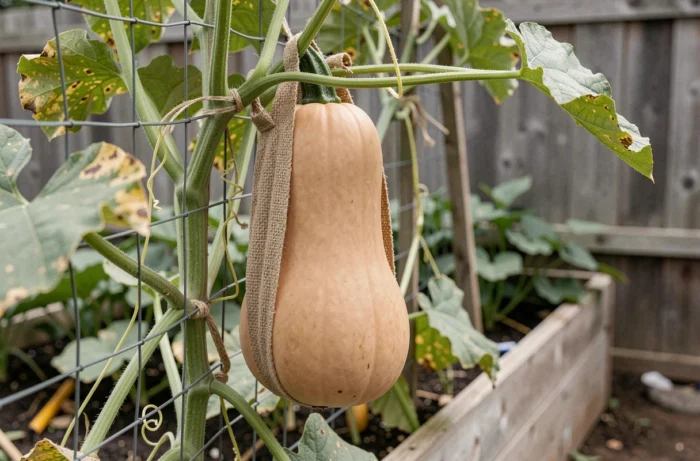
As soon as a fruit reaches the size of a grapefruit, it should be placed in a net or an old pantyhose tied directly to the trellis. This hammock transfers the weight of the fruit from the stem to the metal structure.
Without this support, the stem can snap or the fruit can fall before maturity. The hammock is attached to the trellis, not to the plant’s stem: this is the difference between a successful harvest and lost fruits on the ground.
Butternut trellised on a balcony: regulatory constraints in co-ownership
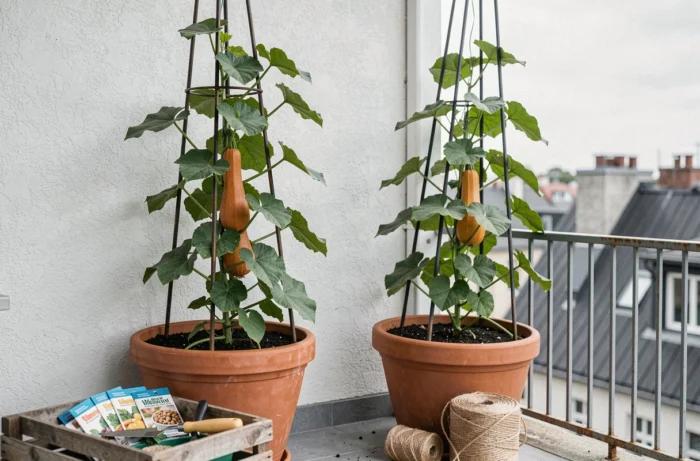
Vertical cultivation in pots on a balcony appeals to urban gardeners, but the installation of the support sometimes falls under the co-ownership regulations. Pots placed on the ground are generally considered light installations that do not require any special authorization.
On the other hand, any anchoring of trellis on the facade or any visible fixed structure from the outside may require the approval of the property manager, or even a vote in the general assembly. The distinction depends on whether the installation is removable or permanent and its visual impact on the common areas.
Before fixing hooks into a balcony wall, checking the co-ownership rules can prevent future disputes. A self-supporting trellis weighted down, placed without drilling, bypasses this constraint while providing sufficient height for the butternut.
Pruning and vertical training: limiting stems to concentrate production
Trellising butternut does not exempt from pruning. Pruning the main stem after the sixth or seventh node encourages the development of lateral branches where the fruits form. Each lateral branch is pinched off after the second fruit is set.
This practice limits the total number of fruits per plant, but each remaining fruit receives more sap and grows better. On a trellis, keeping too many unpruned stems creates a tangle of foliage that reduces air circulation and promotes powdery mildew.
Watering at the base, without wetting the foliage, complements this sanitary strategy. A thick mulch around the base of the plant maintains soil moisture in the square meter dedicated to the plant.
Trellised butternut requires weekly monitoring: checking the tension of the hammocks, guiding new stems toward the trellis, removing unnecessary suckers. This management time remains modest compared to the constant weeding required by a sprawling culture spread over several square meters. The true gain of verticality is not only measured in freed surface area but also in hours of maintenance saved per season.