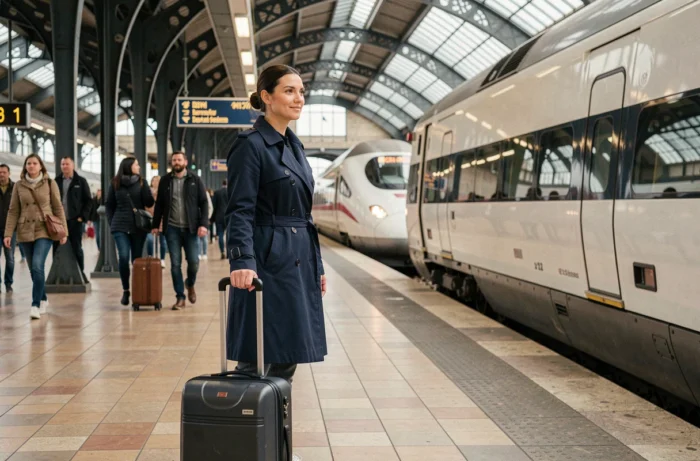
Traveling from point A to point B is not just about buying a ticket. The choice of transport mode affects the budget, comfort, and ability to respond to unforeseen events. Train, bus, carpooling, plane, ferry: each solution meets different constraints depending on the distance, destination, and level of flexibility sought.
Ban on certain domestic flights: what the Climate and Resilience law changes
Since 2023, France has banned certain domestic flights when a direct rail alternative of less than 2 hours and 30 minutes exists. This measure, stemming from the Climate and Resilience law, was extended in 2024. It affects routes such as Paris-Lyon, Paris-Nantes, or Paris-Bordeaux.
For travelers, the consequence is concrete: on these routes, flying is no longer an option. The rail offer has been strengthened in parallel, with increased frequencies. Before planning a domestic itinerary, checking if the flight connection still exists can avoid a nasty surprise on the day of departure.
This regulatory constraint also encourages rethinking connections. A Paris-Toulouse trip remains accessible by plane, but a Paris-Lyon followed by a Lyon-Toulouse can combine two fast rail segments. Comparing end-to-end solutions, rather than mode by mode, often saves time and money. For this, the transport offered by 1, 2, 3 … travel! allows you to visualize the available combinations based on the chosen destination.

Long-distance trains in France: reliability and concrete limits
High-speed trains remain the most popular mode for long-distance travel in France. SNCF transports tens of millions of passengers each year on its TGV network, and punctuality on these lines far exceeds that of equivalent domestic flights.
A rarely mentioned point: compensation for delays is underutilized. According to Le Courrier des Stratèges, SNCF pays out about 70 million euros in compensation that no one claims. The 30-minute guarantee (G30) allows for partial reimbursement from 30 minutes of delay on a TGV. Activating this request via the SNCF Connect app takes just a few minutes.
When the train becomes less relevant
On cross connections (Bordeaux-Lyon, Toulouse-Strasbourg), the high-speed network often requires a detour through Paris. Travel time increases, as do fares. In these cases, long-distance buses or carpooling become credible alternatives, not only for the budget but also for the total door-to-door time.
Buses and carpooling: balancing price, duration, and flexibility
The collective road transport fleet in France has about 95,300 vehicles in circulation in 2026, according to data reported by Aguila. The long-distance bus offer (FlixBus, BlaBlaCar Bus) now covers the majority of major French cities and many European destinations.
Carpooling significantly increases when gasoline prices rise. BlaBlaCar’s figures, reported by Ouest-France, confirm that the rise in fuel prices directly encourages drivers to offer seats and travelers to take advantage of them. On a simple round trip, savings often reach around twenty euros compared to the train, according to a report by La Dépêche.
- Buses are suitable for planned trips in advance, with fixed schedules and very low fares if booked early.
- Carpooling offers more flexibility on schedules and pickup points, with direct contact with the driver.
- On medium distances (two to four hours), these two modes compete with the train in door-to-door time, as they sometimes serve points closer to home.
Traveling abroad: formalities, insurance, and European passenger rights reform
Crossing a border adds a layer of complexity. Beyond the choice of transport, the peace of mind of a stay abroad relies on three pillars: the validity of documents, coverage in case of unforeseen events, and knowledge of one’s rights.
Formalities and travel documents
A passport valid for six months after the return date is required by many countries outside the Schengen area. For European destinations, an identity card is sufficient, but checking its actual expiration date (and not the printed date, which may differ depending on extensions) avoids boarding refusals.
Travel insurance: what the credit card covers (or does not)
Most credit cards include travel insurance if the ticket was paid for with the card. Coverage varies by tier: cancellation, baggage, repatriation, medical expenses. Reading the general conditions before departure helps determine if additional insurance is necessary, especially for long stays or distant destinations.

Air passenger rights and European reform
European regulation EC 261/2004 guarantees compensation in case of a canceled flight or a delay of more than three hours, which can reach up to 600 euros depending on the distance. France Guyane reports that a European reform of passenger rights is underway, aiming to strengthen and clarify these protections. Keeping track of this reform’s progress allows anticipation of available recourse during the next trip.
Applications and tools to compare transport modes
Planning a multimodal itinerary without a dedicated tool means manually comparing the schedules of each operator. Several applications aggregate train, bus, carpooling, and flight results on a single interface.
- Omio and Trainline compare fares and schedules from multiple rail and bus companies across Europe.
- Google Maps now integrates local public transport, including urban networks (metro, tram, city buses), making it easier to calculate door-to-door time.
- The operators’ own applications (SNCF Connect, FlixBus, BlaBlaCar) offer price alerts and notifications in case of disruptions.
The goal is not to multiply applications, but to master one or two that cover the transport modes used regularly. Centralizing reservations also simplifies the management of receipts in case of compensation requests.
The choice of the right mode of transport rarely depends on a single criterion. A smooth journey is built by crossing the actual door-to-door duration, the available budget, and the ability to adapt if an unforeseen event occurs. On domestic routes where flying has disappeared, trains and buses now share the field, each with their strengths depending on the connection. Internationally, preparing formalities and knowing one’s rights weigh as much as the ticket price.