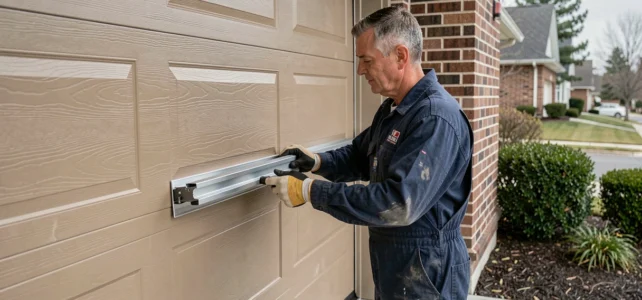
Installing a motorized sectional garage door requires skills in carpentry, electricity, and mechanical adjustment. Success depends less on the number of steps than on the accuracy of initial measurements and compliance with current safety standards. This article compares the technical parameters to check before and during installation and identifies points where improper adjustment compromises the longevity of the whole system.
Safety Standards for Motorized Sectional Garage Doors
Competitors rarely mention the specific texts governing the installation. The standard EN 13241-1, applicable since May 1, 2005, mandates three devices as soon as a garage door is motorized: a fall prevention system, a finger trap protection, and an obstacle detector.
The NF EN 12453 standard, which specifically concerns automation, adds additional requirements: slowing down at the end of the travel, immediate stop in case of resistance, limited crushing force, and the possibility of manual opening in case of power failure. The updated versions (EN 12453:2017+A1:2021 for safety of use, EN 12604:2017+A1:2020 for mechanical requirements) strengthen the testing methods for springs and weight compensation mechanisms.
Each step of the installation of a motorized sectional garage door must incorporate these constraints: the positioning of the obstacle detector, the safety travel of the motor, and the adjustment of the pushing force are not optional finishes but regulatory obligations.
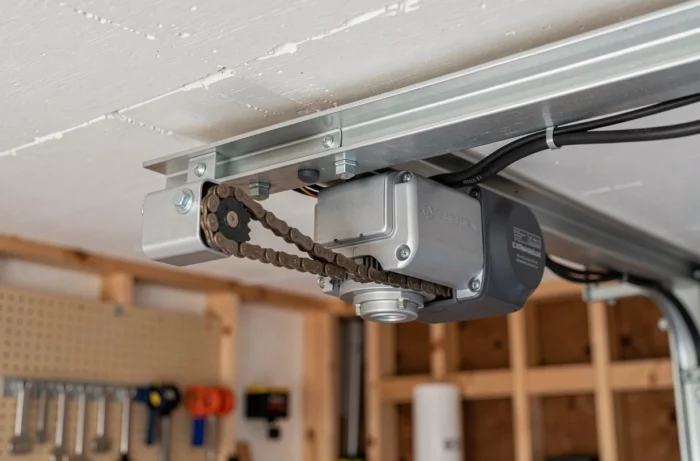
Dimensional Constraints and Clearances: Comparative Table
Before ordering a sectional door, four measurements determine the feasibility of the project. A deviation of a few centimeters on any of them can necessitate a change in model or type of opening.
| Area to Measure | Requirement for Ceiling Sectional Door | Consequence if Insufficient |
|---|---|---|
| Lintel drop (between the top of the opening and the ceiling) | Minimum variable depending on motorization, generally at least the height of the torsion spring plus the motor rail | Inability to fix the motor rail to the ceiling, mandatory shift to a remote motorization |
| Side clearances (wall on each side of the opening) | Sufficient width to fix the vertical rails and mounting brackets | Unstable rails, lateral play of panels, risk of jamming |
| Garage depth | At least the height of the door plus the length of the motor | The motor rail hits the back wall, the door does not open completely |
| Floor flatness | Maximum deviation of a few millimeters across the entire width of the opening | Bottom seal that does not press down, air and water infiltration, premature wear |
Measurements are taken at three points for each dimension (bottom, middle, top for width; left, center, right for height). Always retain the smallest measurement to prevent a panel from rubbing against the masonry.
Adjustment of Torsion Springs and Balancing the Door
Balancing is the most underestimated technical point during a self-installation. Torsion springs compensate for the weight of the panels so that the motor does not have to work hard. Poor adjustment shortens the lifespan of the gear motor and generates audible jolts with each cycle.
Balancing Test without Motorization
Before connecting the motor, the door must remain stationary at mid-travel when released. If it drops, the springs are insufficiently tensioned. If it rises, the tension is too high. The door must hold itself at any height without assistance.
This test is performed with the motor disengaged. Any tension correction on a torsion spring requires a suitable tool (re-tensioning bar) and a firm grip, as the energy stored in the spring can cause serious injuries. The EN 12604:2017+A1:2020 standards precisely govern the testing methods for these compensation mechanisms.
Signs of Imbalance After Motor Installation
- The motor struggles to open but closes quickly: under-tensioned springs, the weight of the door is not sufficiently compensated.
- The motor strains during closing and the door slams to the ground: over-tensioned springs, the residual force pushes the door upward.
- The motor randomly goes into safety mode: resistance varies with the position of the door, indicating a fatigued spring or misaligned rail.
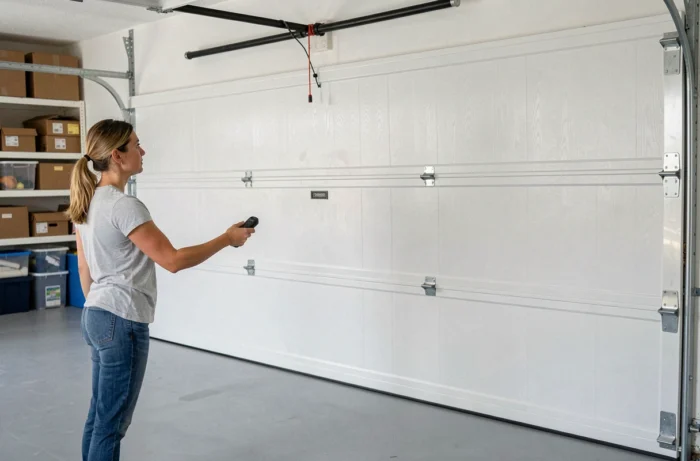
Motorization of Garage Doors: End-of-Travel Parameters and Obstacle Detection
Once the panels are mounted and the springs balanced, adjusting the motor determines daily comfort and regulatory compliance. Two parameters take precedence over all others.
The first is the high and low travel. The motor must stop exactly when the last panel flushes with the lintel (open position) and when the bottom seal touches the ground (closed position). An adjustment that is too short leaves a gap at the bottom; an adjustment that is too long crushes the seal and unnecessarily stresses the mechanism.
The second parameter is the sensitivity of the obstacle detector. The NF EN 12453 standard requires an immediate stop of the door in case of resistance. On most motorizations, this sensitivity is adjustable in increments. A setting that is too loose makes detection ineffective; a setting that is too tight causes random stops at the slightest friction of the seal.
The slowing down at the end of travel, required by the same standard, protects both the mechanism and the users. On some motors, this slowing can be set separately from the nominal speed. Ensuring that deceleration begins well before contact with the ground prevents repeated shocks that deform the bottom panel over the months.
Post-Installation Maintenance and Durability of Panels
The longevity of a motorized sectional door depends as much on maintenance as on the quality of the initial installation. Two simple actions cover most of the needs.
- Lubricate the roller shafts, inter-panel hinges, and torsion spring once or twice a year with a non-greasy lubricant (such as silicone) to limit wear and noise.
- Check the obstacle detector and the fall prevention system at each change of season: place an object on the ground under the door while closing and verify the immediate stop.
- Visually inspect the traction cables and wall fixings of the rails to spot any signs of oxidation or loosening.
A sandwich panel with a damaged peripheral seal quickly loses its insulating power. Replacing a seal is inexpensive, but delaying this intervention allows moisture to infiltrate between the cladding and degrade the insulating core of the panel.
Compliance with safety standards, precision in measurements, and balancing of springs form a triptych where no element compensates for the other. A perfectly sized door but poorly balanced will wear out its motor in a few years. Conversely, careful balancing on poorly fixed rails will eventually cause misalignment of the panels. Each parameter deserves the same level of attention from the very first hour of installation.