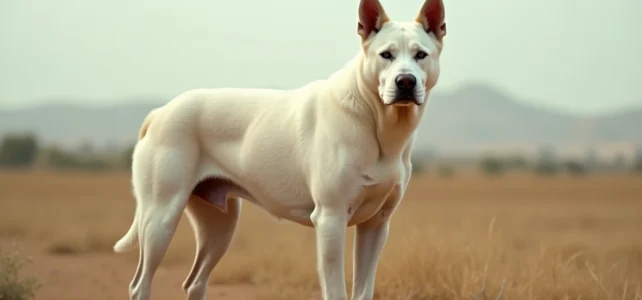
A dog that can weigh as much as an adult human, which no major dog club in Europe officially recognizes: the Bully Kutta intrigues as much as it impresses. Originating from the Indian subcontinent, this massive mastiff descends from ancient war lines and retains a marked territorial temperament. Before welcoming one into your home, it’s best to understand what sets it apart from other mastiffs and to gauge the real constraints of its training.
Lineage with the Alaunt: what the history of the Bully Kutta changes for breeding
Most breed profiles simply mention “India/Pakistan” as its origin. This simplification masks a much more precise heritage. Research by dog enthusiasts specialized in South Asia describes the Bully Kutta as descended from the war dogs of the Mughal armies, which themselves descended from the Alaunt type imported by merchants and invaders.
This selection has been refined in the regions of Punjab and Sindh, where the warm climate and guarding needs have shaped a dog that is both resilient and dominant. Why does this historical detail matter for a future owner? Because it explains deeply ingrained character traits.
A dog selected for centuries for war and protection does not react like a retriever raised to fetch game. Its reactivity to strangers, tendency towards dominance, and natural mistrust are not “flaws” but remnants of its original function. Anyone wishing to learn everything about the bully kutta must start from this genetic reality to adapt their educational approach.
Bully Kutta and French legislation: a legal void to anticipate
The Bully Kutta is neither recognized by the FCI nor by major European dog clubs. In France, this lack of an official standard creates a problematic gray area, as the categorization of powerful dogs relies on belonging (or morphological resemblance) to listed breeds.
An adult Bully Kutta can be visually classified as a category 1 or 2 dog by law enforcement, with the obligations that this entails: muzzle in public places, declaration at the town hall, behavioral assessment, specific civil liability insurance. Without recognized breed papers, the owner finds themselves in a position of having to prove that their dog does not fall into a category.
Before any acquisition, contact your local town hall and a veterinary behaviorist. Request a preventive assessment to obtain an official document certifying the animal’s temperament. This step does not guarantee the absence of complications, but it constitutes a file in case of inspection.
Importing into the European Union
Bringing a Bully Kutta from Pakistan or India requires compliance with European health protocols (rabies vaccination, microchip, international veterinary certificate). The additional difficulty lies in the absence of a recognized pedigree: customs may require additional proof of the animal’s origin.
Training the Bully Kutta through positive reinforcement: method and limits
You may have heard that only a “firm hand” works with a mastiff of this size. This misconception often leads to coercive methods that worsen the dog’s reactivity instead of channeling it.
Positive reinforcement remains the most reliable method for a Bully Kutta, provided it is applied consistently and started very early. The principle is simple: reward every desired behavior (sit, recall, loose leash walking) and ignore or redirect undesirable behaviors.
What works concretely
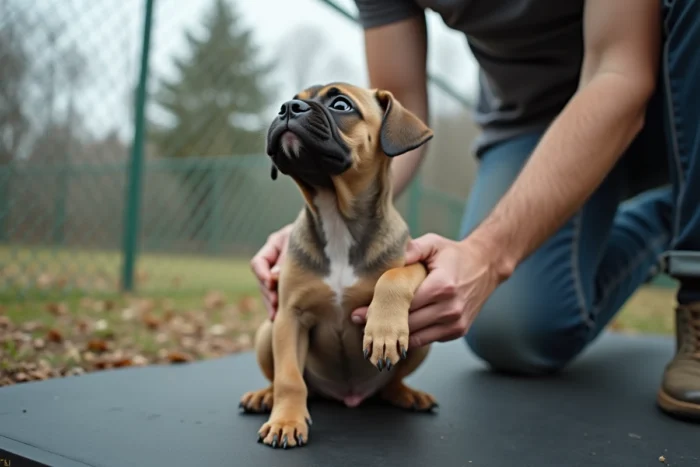
- Socialization from the first weeks: exposing the puppy to varied environments (urban noises, other animals, people of all ages) before it reaches its critical behavioral development period
- Short and frequent sessions, never more than ten minutes, as this dog quickly tires of repetition and can become stubborn if the session drags on
- Using a high-value reward (dried meat, cheese) rather than simple kibble, to maintain its motivation in the face of distractions
- A structured living environment with fixed rituals: meal, walk, and rest times always the same
The limit of positive reinforcement alone appears when the dog reaches its adult size without having been properly socialized. At this stage, consulting a dog trainer specialized in mastiffs becomes essential, not optional.
Health and living conditions suitable for the Bully Kutta
A dog of this size has physical needs that many underestimate. Apartment living is to be excluded, not by convention but by spatial reality. This mastiff needs a fenced area where it can move freely for several hours a day.
The joints are the main weak point of this breed. Hip and elbow dysplasia frequently affects poorly selected lines, precisely because the absence of an official standard prevents systematic control of breeders.
Nutrition and veterinary follow-up
The daily ration must be adapted to its mass and activity level. Splitting into two meals a day reduces the risk of stomach torsion, a serious condition in large deep-chested dogs. Regular veterinary follow-up, at least two visits per year, allows for early detection of joint problems.
- Favor a diet rich in animal proteins and low in processed grains
- Avoid intense exercise just after meals to limit the risk of gastric dilation
- Monitor weight gain, as every extra kilo increases pressure on the joints
The Bully Kutta is not a dog to choose on a whim after seeing a video on social media. Its power demands an owner who is clear about their own capabilities, available space, and veterinary budget. Those who accept these constraints discover a companion of uncommon loyalty, capable of forming a deep bond with their family, provided that the framework is established from the start.