Creative interior decoration is not just about repainting a wall or putting up a shelf. Each DIY project involves choices of materials, finishes, and compatibility with indoor air quality. Here are ten concrete ideas to transform a space, combining DIY techniques with current requirements.
1. Textured lime plaster on an accent wall
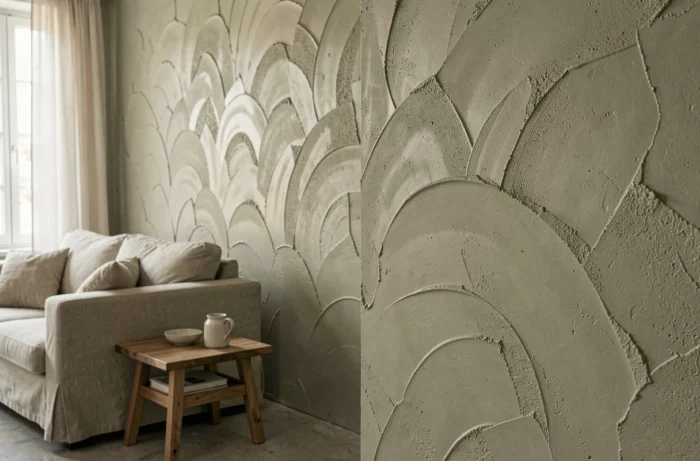
Aerial lime plaster offers a breathable mineral finish that naturally regulates ambient humidity. Applied in two crossed passes with a stainless steel trowel, it produces a matte velvet texture that is impossible to achieve with conventional paint.
We recommend working on a pre-moistened surface to avoid crazing. Choose hydraulic lime NHL 2 for damp rooms, and aerial lime CL 90 for the living room. Adding natural pigments (ochres, sienna earths) allows for muted shades without resorting to synthetic dyes that emit VOCs.
In France, interior decoration products must display a VOC emission label (ranking A+ to C). Checking this ranking before purchasing ready-to-use plaster remains the simplest precaution to preserve air quality.
2. Library made of solid wood slats
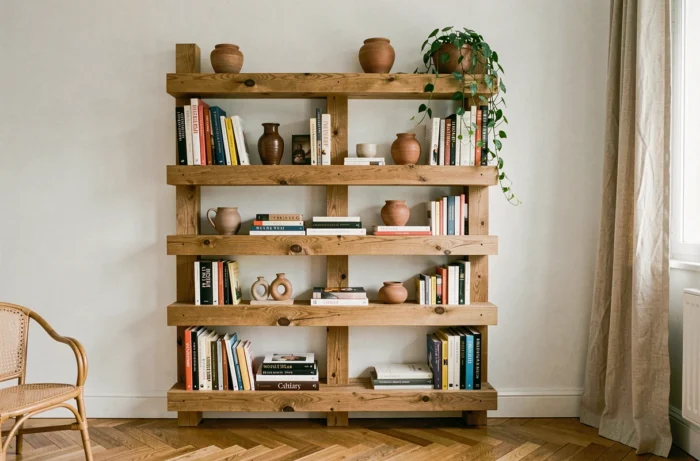
The vertical slatted screen serves as both open storage and a visual separator. The standard section of 27 x 27 mm in pine or oak is suitable for decorative use without a load-bearing function.
Fixing each slat to horizontal crosspieces (at least two, top and bottom) ensures regular alignment. We observe that spacing a few centimeters between each slat creates a play of shadows that structures a wall without closing it off, an effect that the bookshelf wealth trend exploits by saturating these open shelves with objects, books, and souvenirs.
Exploring interior decoration with Cécile Bricole allows you to find mounting templates and wood-color combinations suitable for each room.
3. Cast terrazzo for a coffee table top
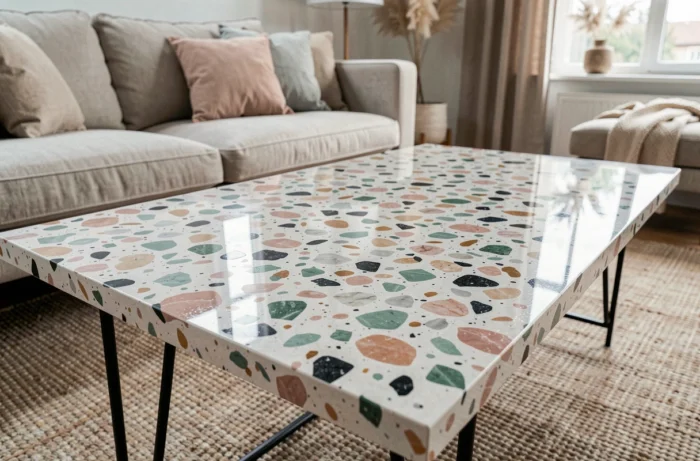
Pouring a terrazzo top requires a waterproof form, a mix of white cement and marble or recycled glass chips, followed by progressive sanding with fine grit. The result produces a unique surface that cannot be exactly replicated.
The minimum thickness for a self-supporting top is around three to four centimeters. Beyond this thickness, weight becomes a factor to consider in choosing the base. A welded steel tube base supports the load easily, unlike a low-section wooden base.
4. Panoramic wallpaper applied in a single strip
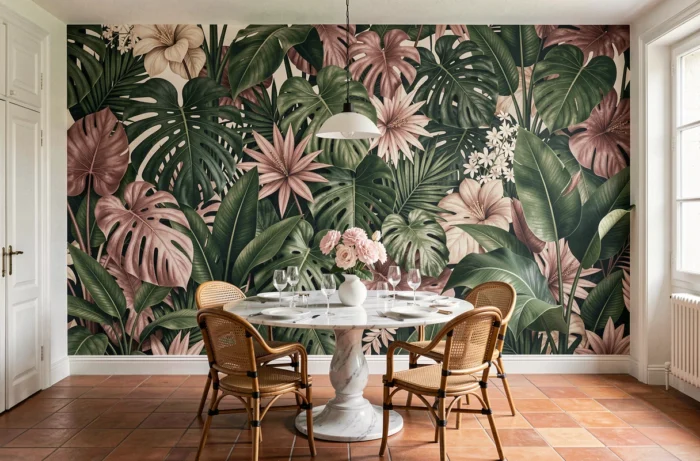
The single panoramic strip covers an entire wall without seams. The installation requires a perfectly smooth surface and wall gluing (reverse paste technique) to avoid air bubbles under a wide non-woven wallpaper.
Opt for a non-woven paper certified A+ for VOC emissions. Large-format botanical or geometric patterns replace a painting and transform the ambiance of a room in a single intervention.
5. Hanging light fixture made of woven natural fiber
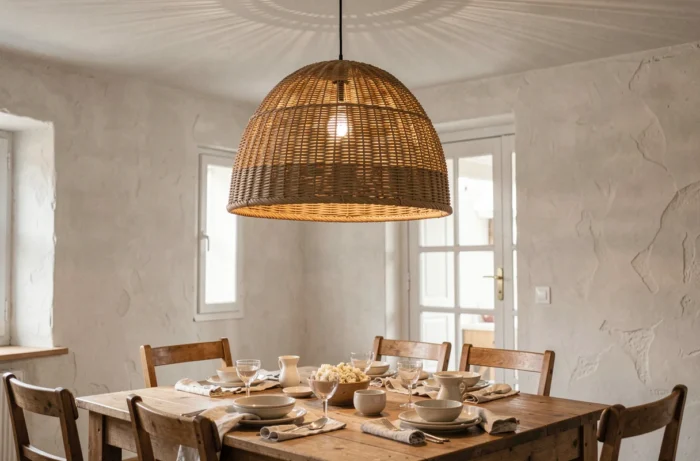
Weaving a lampshade from rattan, raffia, or sea rush around a metal wire structure creates a light fixture that diffuses soft light. The natural fiber filters direct light and casts patterns on the ceiling.
Use a ceramic E27 socket (heat-resistant) and an LED filament bulb with a color temperature not exceeding 2,700 K. This type of light fixture fits into an eco-responsible decoration approach, provided that the fiber has not undergone unlabelled chemical treatment.
6. Painted baseboard in contrasting two-tone
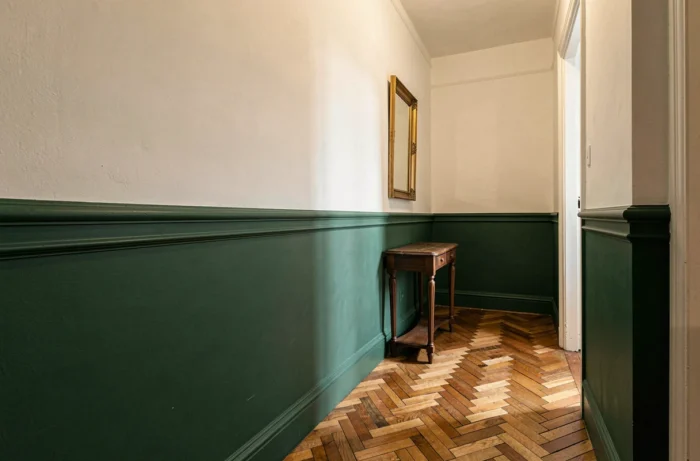
Painting the lower third of a wall in a deeper shade than the rest creates a horizontal line that visually lowers the ceiling height and structures a hallway or entryway. The dopamine decor technique pushes this principle further by combining bright colors, sometimes complementary, for a deliberately playful effect.
The sharp demarcation line requires quality masking tape and immediate removal after application. Any delay causes fresh paint to peel.
7. Vintage mirror found and custom-framed
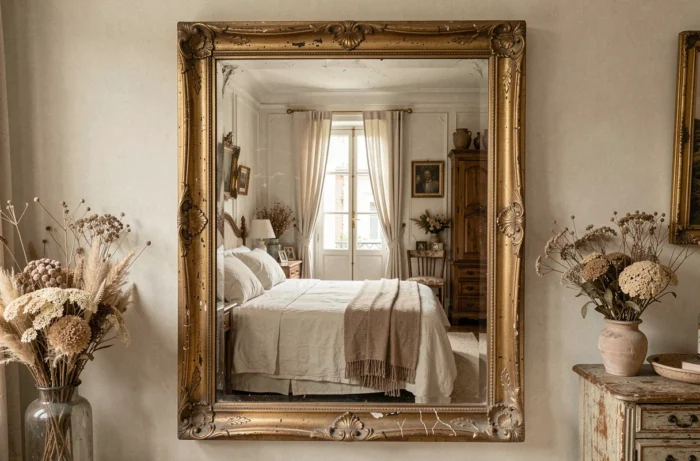
A fireplace or trumeau mirror recovered from a flea market can be resized by a glazier to fit a specific space. We recommend keeping the original frame, even if damaged: an authentic patina has more character than a new frame.
Check the condition of the silvering before purchase. Pitted silvering creates a sought-after vintage effect, but peeling silvering compromises the reflective function. Professional resizing costs less than a new decorative mirror of equivalent size.
8. Plant screen with integrated hanging pots
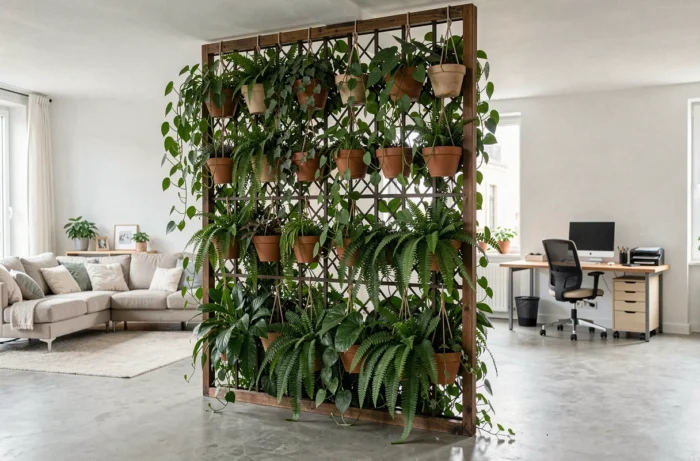
Combining a wooden screen with hanging pots in macramé or glazed ceramic creates a living partition. Trailing plants (pothos, ceropegia) enhance the separation effect without blocking light.
Three technical constraints to respect:
- The combined weight of the pots filled with water must remain compatible with the wall fixing (suitable anchors for the support: plasterboard, brick, concrete).
- Plan for a water recovery system (saucer or reservoir pot) to protect the wood of the screen.
- Orient the screen towards a source of sufficient natural light for the chosen species.
9. Waxed concrete applied over an old tiled countertop
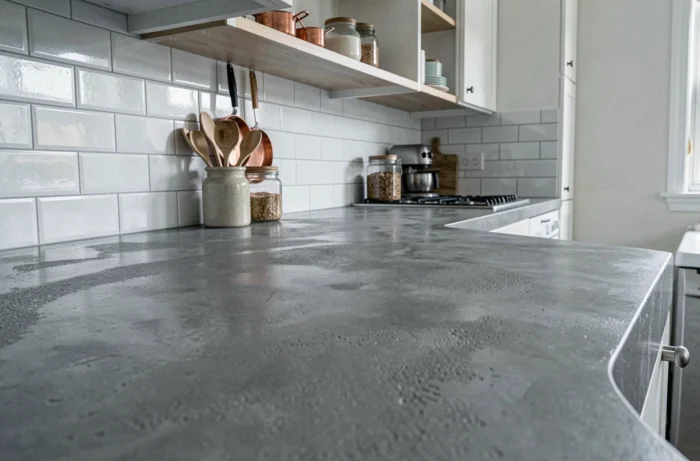
Waxed concrete adheres directly to existing tiles provided that a suitable bonding primer for closed surfaces is applied. Two thin layers (less than one millimeter each) are sufficient for a smooth and contemporary finish.
The finish with a matte polyurethane varnish protects the surface against food stains and micro-scratches. Without this protection, waxed concrete absorbs liquids and stains irreversibly. Choose a varnish rated A+ for emissions to remain consistent with indoor air quality.
10. Applied moldings on standard flat doors
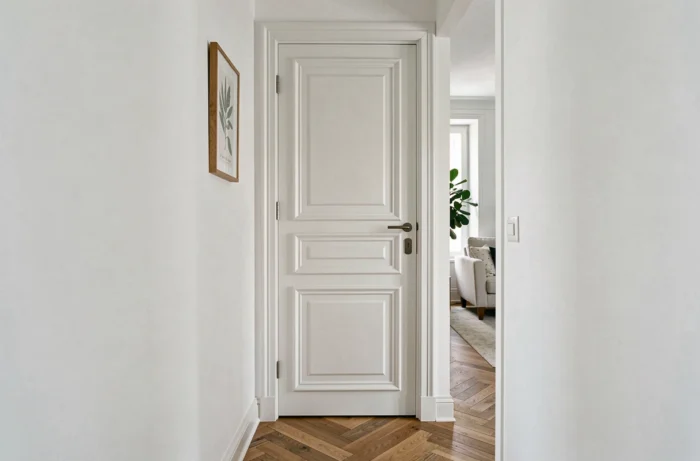
Gluing molded strips in wood or high-density polystyrene onto a flat isoplane door transforms a basic joinery into a stylish door. The most readable design remains the centered rectangular frame, which works well in both classic and contemporary interiors.
Use a polymer mounting adhesive (solvent-free, rated A+ for VOCs) rather than nails, which can crack the polystyrene. After drying, a primer followed by two coats of satin paint unifies the door and moldings into a single visual block.
Each of these interventions alters the perception of a space without engaging in heavy work. The common point among all: systematically check the VOC emission labeling on each product used, the only tangible guarantee of an aesthetic and healthy interior.