
You order an IKKS jacket online, receive the package, and the fit is tight at the shoulders while the size corresponds to what you wear with other brands. This scenario happens often because the IKKS men’s sizing varies depending on the type of piece, the chosen cut, and even the fabric composition.
Elastane and textile material: the criteria that size guides overlook
Before looking at a size chart, you save time by checking the garment’s composition on the product sheet. A pure cotton chino does not react at all like a stretch jean containing elastane.
The less elastane the fabric contains, the more you should anticipate a tight fit. A thick cotton jacket without stretch fibers is less forgiving of measurement discrepancies than a jacket lined with a cotton-elastane blend. On structured pieces (coats, suit jackets), the comfort margin decreases further due to the shoulders and armholes.
Specifically, when you’re hesitating between two sizes on a rigid piece, opting for the larger size remains the most reliable reflex. However, for a stretch t-shirt or polo, your usual size generally fits well. Knowing how IKKS sizes for men starts with reading the composition label.
IKKS men’s cuts: slim, regular, and oversize fit differently
The official size guide provides correspondences for chest and waist measurements, but it says little about the effect of the cut. At IKKS, the same size M can fit very differently depending on whether you choose slim pants, regular cargo, or an oversize coat.
Fitted pieces: shirts, suit jackets, slim jeans
On fitted cuts, IKKS tends to run small. The shoulders are narrow, and the torso length is short. If you usually wear size M with brands that have standard sizing, you may need a size L for an IKKS structured jacket.
For slim jeans, the friction point is at the thighs. The denim used often contains elastane, which partially compensates for the tight fit, but not always enough to stick with your usual size.
Loose pieces: coats, parkas, oversize t-shirts
IKKS coats and parkas adopt more generous cuts. You can often keep your usual size or even go down a size if you don’t plan to layer multiple items underneath. Returns vary on this point depending on the collections, so caution is advised.
Taking measurements for IKKS: the three areas to check
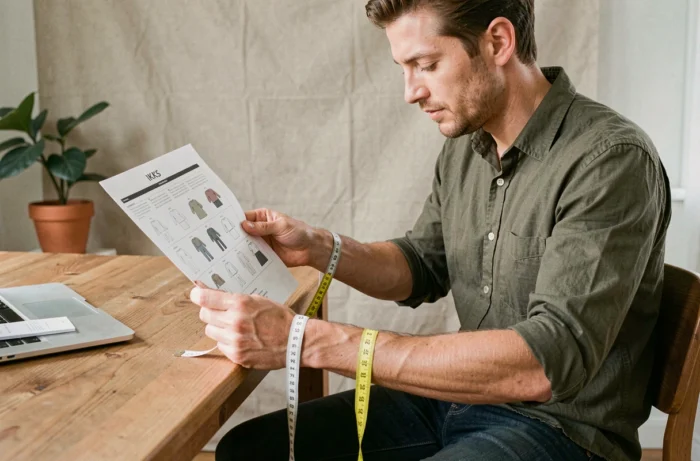
A measuring tape and two minutes are enough. Three measurements cover the majority of purchasing cases for IKKS men:
- Chest measurement: measured under the armpits, at the widest point of the bust, arms along the body. This is the priority measurement for tops, jackets, and coats.
- Waist measurement: taken at the level of the navel (not above the hip). Determinant for pants, chinos, and jeans.
- Hip measurement: especially useful for cargo pants and straight cuts, measured at the widest point of the hips.
You then compare these numbers to the IKKS size guide available on each product sheet. The site also offers the True Fit tool, which cross-references your measurements with the cut data of the selected piece to suggest a personalized size.

IKKS returns and exchanges: anticipating size errors
Even when taking your measurements, an error is still possible. A few points to know before finalizing an order:
- Purchases on the official IKKS site can be returned according to the current general sales conditions. Check the applicable deadline at the time of order.
- Items purchased online are not always exchangeable in physical stores. This depends on the store’s policy.
- Ordering two close sizes remains the safest method for expensive pieces like leather jackets or coats, provided you return the unsuitable size within the deadlines.
IKKS occasionally reports delivery suspensions in certain geographical areas. Before placing an order, a quick look at the delivery information displayed at the top of the site can prevent a prolonged wait that would complicate a potential return.
Choosing a size at IKKS for men hinges on three variables: the material of the garment, its cut, and your actual measurements. A size correspondence chart provides a starting point, but it is the careful reading of the product sheet, including textile composition, that makes the difference between a successful purchase and a returned package.