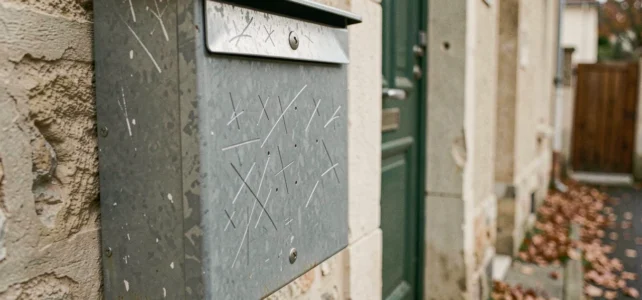
The markings left on or near mailboxes regularly fuel local alerts and discussions among neighbors. Spotting a sign of marking on the mailbox before a burglary requires distinguishing a real clue from mere coincidence. Law enforcement reminds us that a marking is never formal proof, but rather an indicator among others that justifies increased vigilance.
The white sheet sticking out: absence testing technique
Among the methods relayed by local authorities in recent months, the white sheet inserted into the mailbox so that it visibly sticks out has become the most commented signal. The town hall of Douvres-la-Délivrande issued an alert on this matter in July 2026, which was later picked up by several regional media outlets.
The principle is simple: an individual deliberately slips a sheet or flyer that sticks out. If the sheet remains in place for several days, it signals that no one is collecting the mail, indicating that the residence is likely unoccupied. The spotter can then return or pass on the information.
When you spot a sign of marking on the mailbox, the first recommended reflex in 2026 by the gendarmerie is to photograph the clue before touching it, then keep it flat if you plan to report the facts. This precaution allows investigators to have a tangible element, even if most of these reports do not lead to a procedure.
However, the presence of a white sheet alone does not constitute proof of burglary spotting. A commercial flyer or misdelivered mail can produce the same visual effect. It is the accumulation of clues (unremoved sheet, additional traces, unusual passages) that should raise alarms.
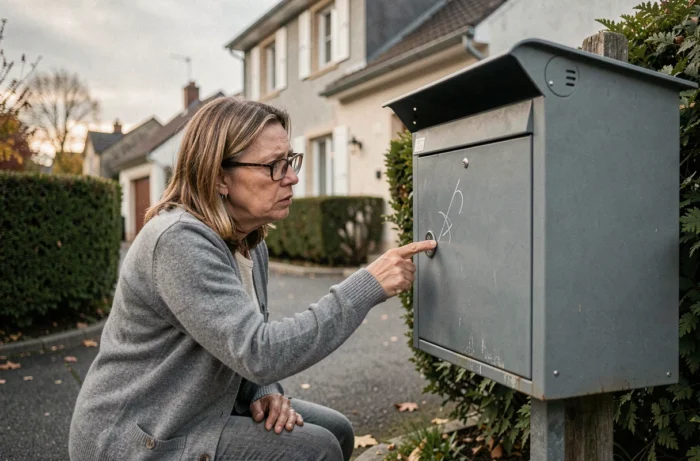
Physical markings on the mailbox and its surroundings: what field reports show
Symbols drawn with markers, pencils, or chalk on mailboxes, walls, or gates have been the subject of numerous articles for several years. Crosses, diamonds, triangles, small circles, isolated letters (N, M, AM, D): these codes circulate widely online.
Real reliability of these symbols
Field reports vary on this point. Some gendarmes confirm having observed these marks in the context of investigations, while others downplay their significance. No centralized official directory validates the meaning of each symbol. The interpretations found online (cross = easy target, diamond = empty house) often come from local testimonies, not consolidated data.
What is documented more reliably are the physical testing techniques:
- A line of glue applied to the edge of the front door or gate, whose breakage indicates a recent opening.
- A business card or string wedged in the door frame, which falls if someone enters or exits.
- Small pebbles or gravel placed unusually near the mailbox or threshold, whose movement betrays a passage.
These methods serve the same purpose as the white sheet: to check whether the home is occupied or not. They are mentioned in alerts from municipalities in Ille-et-Vilaine and Finistère relayed by local press in 2025-2026.
Where to look concretely
The mailbox itself is not the only support. Burglars also use the sidewalk in front of the gate, the street-side fence wall, the edge of the doorbell, or underneath the doormat. A quick examination of these areas upon returning home, especially after being away for several days, takes less than a minute.
Digital spotting and social networks: an often underestimated angle
Competing content focuses on physical markings, but the spotting phase often begins online. Burglars consult social networks to identify absences: geolocated vacation photos, stories posted from an airport, comments announcing a departure.
The link to the mailbox is direct. A home identified via social networks as unoccupied will then undergo a physical test (sheet, pebble, glue line) to confirm the absence on site. The two methods combine.
Several municipalities and the Police Prefecture remind us of a basic reflex: do not publish absence clues in real-time. Posting vacation photos upon return rather than during the stay reduces the exposure window.
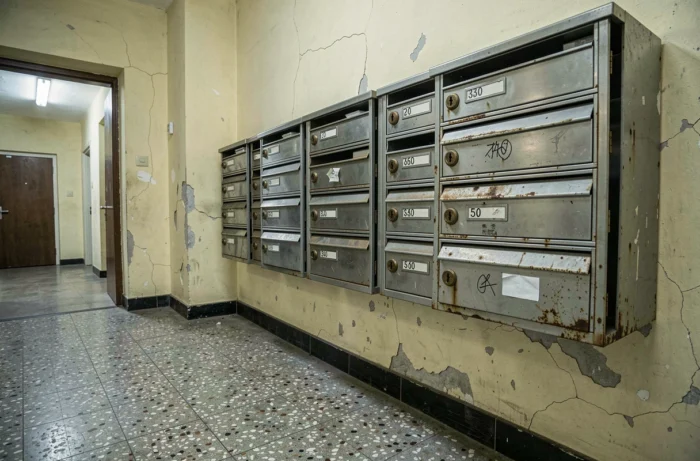
What to do after spotting a suspicious clue near the mailbox
The reaction should be proportionate. An isolated clue does not justify panic but deserves attention.
- Photograph the clue as it is, with a visual reference (date on the phone, overall view of the mailbox).
- Remove the marking or sheet after the photo, to signal to the spotter that the home is being watched.
- Notify immediate neighbors: if several mailboxes in the neighborhood show similar marks, a grouped report carries more weight.
- File a report or contact the local gendarmerie. The number 17 remains the reflex in case of a suspicious situation in progress.
Installing a surveillance system (camera, connected alarm) deters more than it solves the immediate problem, but it is a logical complement for a home that has already been spotted. The visible presence of a camera changes the risk-benefit calculation for the burglar.
The marking on the mailbox remains a weak signal. Its value lies in what it triggers: a renewed vigilance, an exchange with the neighborhood, a report to the authorities. The most reliable detection system remains a neighborhood where residents communicate with each other.