
What mechanisms distinguish a truly effective online educational game from mere entertainment disguised as schoolwork? The answer lies less in the displayed content and more in how the software adjusts difficulty, handles mistakes, and keeps the child in a productive effort zone. This article compares the pedagogical approaches of free online educational games and identifies the parameters that shift a gaming session into a true learning moment.
Algorithmic Adaptivity in Online Educational Games
Most articles on the subject describe educational games as “playful” or “interactive” without specifying what happens behind the scenes. The major difference between a static exercise and a modern educational game lies in the software’s ability to analyze the child’s mistakes and automatically readjust the exercises.
This mechanism, called algorithmic adaptivity, keeps the difficulty level sufficiently challenging without discouraging the user. The child progresses at their own pace and perceives each new step as a “higher level” rather than as a repetition of a failed exercise.
This logic proves particularly effective for repeated practice and memorization. At home, a child who struggles with multiplication tables can work on their gaps without feeling like they are “doing homework” again. The game identifies specific gaps and offers targeted variations, whereas a workbook imposes the same sequence on everyone.
Several French-speaking platforms offering free online educational games already integrate this type of functionality, with pathways that adjust after each response from the child.
Comparison of Free Educational Game Formats for Children
Not all online educational games rely on the same pedagogical principles. The table below distinguishes three common formats based on their characteristics and effects on learning.
| Format | Main Mechanism | Targeted Skills | Adaptivity |
|---|---|---|---|
| Progressive Level Quizzes | Question-and-answer format with scoring and level unlocking | Reading, multiplication, vocabulary | Low to medium (fixed or semi-adaptive sequence) |
| Interactive Narrative Game | Scenario where the child solves problems to advance the story | Logic, listening comprehension, decision-making | Variable (depends on the application) |
| Adaptive Platform | Real-time error analysis, automatic pathway readjustment | All subjects, with a focus on individual gaps | High |
The progressive level quiz remains the most common format on free sites. It works well for short reviews, but its linear pathway does not adapt to the specific difficulties of each child.
The interactive narrative game has the advantage of engaging the child emotionally. Motivation comes from the desire to know what happens next in the story, not just from a score. However, the educational quality varies significantly from one application to another.
Adaptive platforms combine both approaches: they offer varied activities (reading, multiplication, logic) while adjusting the pathway. This format is less common in the free offering, but several French-speaking providers are developing it.
Discrepancy Between Perceived Effort and Actual Effort in Children
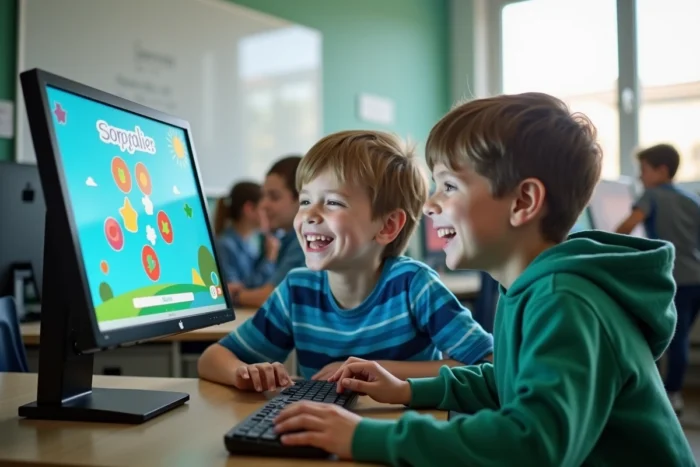
One of the most documented effects of online educational games concerns the gap between what the child believes they are doing (playing) and what they are actually doing (learning). This phenomenon explains why a child may spend more time on a playful exercise than on a traditional assignment, while retaining information better.
Three mechanisms contribute to this gap:
- Immediate rewards (badges, points, character unlocking) create a gratification cycle that encourages voluntary repetition, whereas a school exercise only offers a delayed grade.
- The ability to restart without social consequences removes the fear of failure. The child tries, makes mistakes, restarts, without the gaze of a teacher or peer.
- The playful framing transforms the perception of effort: solving a multiplication to “save a character” mobilizes the same skills as a paper exercise, but the child perceives the activity as a choice rather than an obligation.
This gap only works if the game maintains a balance between challenge and accessibility. If it’s too easy, the child loses interest due to boredom. If it’s too difficult, frustration takes over, and the game loses its advantage over traditional exercises.

Criteria for Selecting a Free Online Educational Game
The range of free online educational games is vast, but their educational quality varies greatly. A few parameters allow for a quick assessment of whether a game is worth the child’s time.
- The presence of explicit feedback after each mistake: a good educational game does not simply display “wrong answer.” It explains why the answer is incorrect or offers a hint to guide toward the solution.
- The absence of intrusive advertisements: on free platforms, banners and video ads can interrupt the child’s concentration every few minutes, negating the benefit of immersion.
- Visible progress: the child should be able to see their advancements (unlocked levels, acquired skills). Without this feedback, motivation wanes after a few sessions.
- Content aligned with school learning: a reading game that uses vocabulary appropriate for the targeted age group will be more useful than a generic game translated from another language without pedagogical adaptation.
Children who struggle with traditional school formats often derive significant benefits from these tools. The online educational game makes effort acceptable by changing the context, not the content.
The Parental Role in Support
An online educational game works better when an adult participates, even occasionally. Watching the child play, commenting on their choices, or discussing what they have learned extends the educational effect beyond the screen.
Parental support also helps identify whether the child is bypassing exercises or getting stuck on the same type of mistake that the software does not correct adequately.
The quality of a free educational game ultimately measures by a simple criterion: does the child return to it on their own, and do they progress between sessions? If both conditions are met, the software fulfills its function, regardless of its development budget.